morning rituals
Morning Affirmations Routine While You Get Ready
A quiet morning affirmations routine you can listen to while washing, dressing, making tea, and beginning the day without waking earlier.
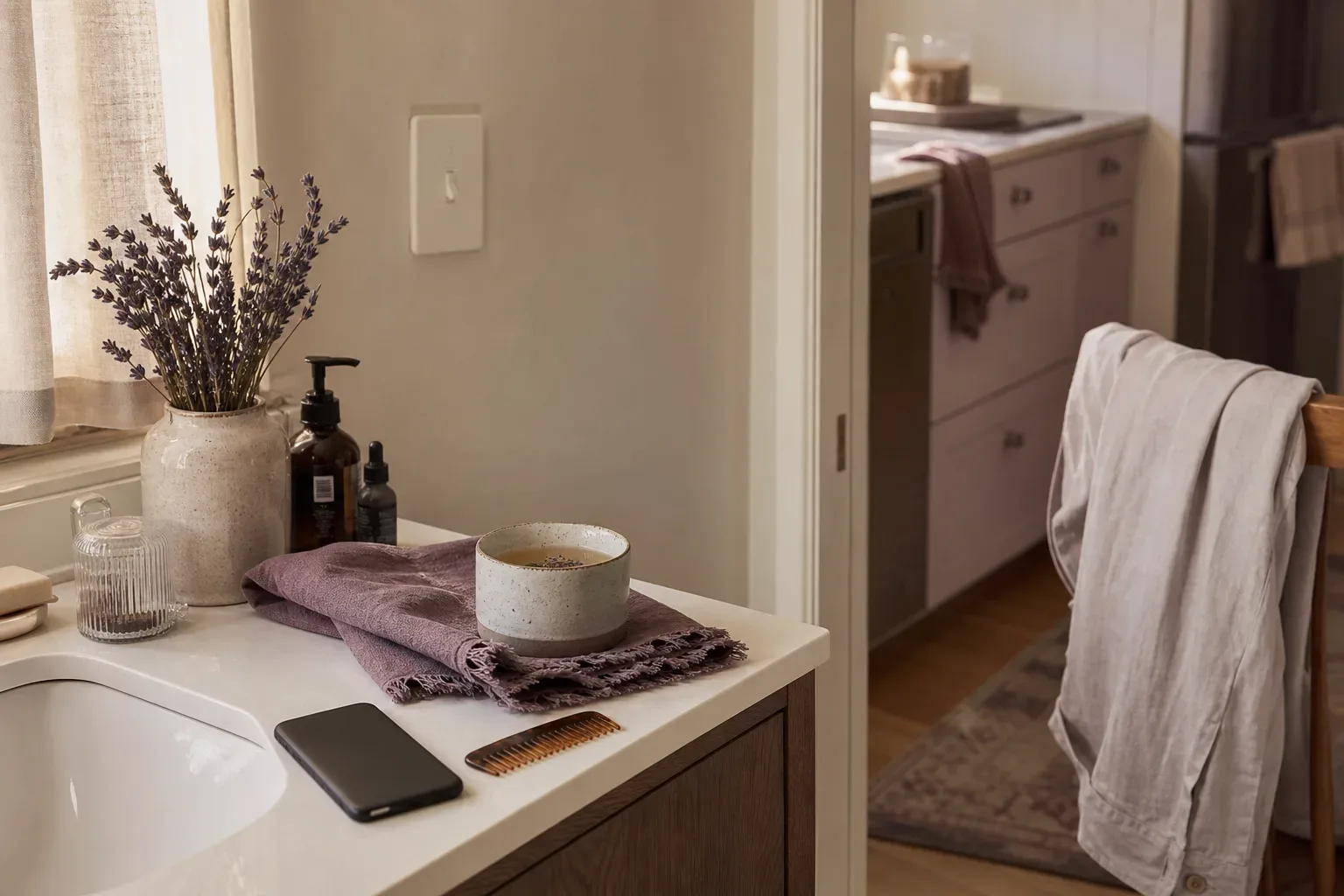
A morning affirmations routine can be as simple as listening while you wash your face, dress, and make tea. You don’t need a longer morning. You need one repeatable cue, one short audio, and one sentence you can carry into the first hour.
Why should you listen while you get ready?
Listening works because it meets the morning where it already is.
The sink is running. A shirt is half-buttoned. The kettle is beginning its small metal breath. This is not a blank, sacred hour. It’s 7:12. Maybe 6:40. Maybe someone is calling from another room. A morning affirmations routine has to live there, not in the fantasy of a perfect morning.
Habit researcher BJ Fogg writes about anchoring a new behavior to something you already do. His Tiny Habits model uses a simple pattern: after I do this, I do that. The cue matters because the brain spends less effort deciding. Pew Research Center reported in 2024 that 97% of U.S. adults own a cellphone, which means the device for audio is usually already within reach before breakfast.
Listening is easier to repeat because it doesn’t ask your tired mind to lead. You press play, then keep moving. This matters. The cortisol awakening response often rises in the first 30 to 45 minutes after waking, according to work summarized by Clow and colleagues in 2010. For many people, that first hour is alert but tender. Words can enter before the day’s noise gets loud.
If you already use affirmations, audio gives them a body. You hear tone. Pace. Breath. You don’t have to manufacture belief from a cold start. You let one steady voice hold the sentence until you can hold it too.
A routine that survives a messy morning is more useful than one that only works on a perfect one.
How do you set up a 12-minute morning affirmations routine?
You set it up by attaching one short audio to one action you already repeat.
Do not begin with a full redesign of your morning. Begin with the hinge. Choose one place where your hands are busy but your mind is reachable. In my greenhouse, it’s the kettle. I fill it before I check messages. That is the old habit. The new habit is pressing play before the water boils.
A 2009 study by Phillippa Lally and colleagues in the European Journal of Social Psychology found that habit automaticity took a median of 66 days, not the popular 21. The range was wide, from 18 to 254 days. So your first task is not intensity. It is returning.
Use this small sequence for the first two weeks:
- Put your phone or speaker where you get ready.
- Choose one anchor: face washing, teeth, dressing, tea, or shoes.
- Press play before opening messages.
- Let the audio run while you move.
- When it ends, repeat one line once, quietly.
- Mark the day with a dot, not a paragraph.
| Morning moment | Best audio length | Why it works |
|---|---|---|
| Washing your face | 3 to 5 minutes | Water gives the body a clear cue |
| Dressing | 5 to 8 minutes | Hands are busy, attention is soft |
| Making tea or coffee | 6 to 10 minutes | Waiting becomes practice |
| Walking to transit | 8 to 12 minutes | Repetition pairs with movement |
The Manifestation pillar names repetition as part of the work because the mind learns through return. Small repetition is not small when it teaches your nervous system what to expect.

What should your morning audio actually say?
Your audio should speak from the self you are practicing, in language your body can believe.
This is where many affirmations become too shiny. They skip the kitchen. They skip the unpaid bill, the tender inbox, the body that didn’t sleep well. Then the mind rejects them. In a 2009 Psychological Science study, Joanne Wood and colleagues found that broad positive self-statements could make people with low self-esteem feel worse. The sentence was too far from what felt true.
So keep the words close. A useful morning affirmation doesn’t deny the real morning. It names the self who can meet it. Instead of I am never anxious, try I can move slowly even when anxiety is here. Instead of everything is perfect, try I know the next right thing, and I can do it without rushing.
Build the audio with three kinds of lines:
- Identity: I am someone who returns to herself before the day begins.
- Evidence: I have kept promises in small ways before.
- Action: I answer the first message after I drink water.
- Future-self memory: I can feel how ordinary this steadiness has become.
Claude Steele’s self-affirmation theory, first described in 1988, was not about pretending. It was about remembering a wider self when threat narrows the mind. Later reviews, including Cohen and Sherman in 2014, found that self-affirmation can reduce defensiveness and support behavior when the statement connects to real values.
Your future self should sound like someone who knows your kitchen. Let the audio mention the cup you use, the coat by the door, the breath before the first conversation. Specificity makes the sentence less like decoration and more like a place to stand.
How does this fit with the AYA Method?
It fits when the audio leads and the affirmation supports it.
The AYA Method is a daily audio manifestation practice. Each day you listen to a short personalized recording — your Dream-Self Moment — narrated from the version of you who has already manifested the life you intend. Listening is the practice. Repetition is the work. The audio is the method.
That distinction matters. A daily affirmation can be a beautiful complement. A Manifestation Board can help you see what you’re practicing. But the audio is the method because it gives you a repeatable meeting with the self you are becoming. Neville Goddard often wrote about living from the end, not as a slogan but as an inner assumption. A Dream-Self Moment gives that assumption a voice you can return to at 7:12, with toothpaste still in the sink.
Dr. Andrew Huberman has often pointed to the nervous system’s sensitivity to morning light and early-day cues. Light within the first hour after waking can help set circadian timing, according to sleep research summarized by the National Institute of General Medical Sciences. Your audio can become another cue. Not a command. A remembered direction.
Here is the quiet order:
- Listen to your Dream-Self Moment.
- Let one affirmation rise from it.
- Carry that line into the first action of the day.
- Use the Manifestation Board later if seeing the image helps.
If you want the wider frame, read the guide to astrology and manifestation with this in mind: timing can be meaningful, but the daily return is what steadies the practice.
What if your morning is rushed, loud, or shared?
Then make the practice smaller until it can still happen.
A routine doesn’t fail because it is short. It fails when it asks for a version of you who is never late, never tired, and never interrupted. If you have children, roommates, an early shift, or a body that wakes slowly, your morning affirmations routine should be almost invisible from the outside.
Implementation intention research by Peter Gollwitzer has shown that if-then plans help people act in the moment: if situation X happens, then I do Y. A 2006 meta-analysis by Gollwitzer and Sheeran found medium-to-large effects across many goal types. That matters here because mornings are full of interruptions. You need a plan for the interruption, not a punishment after it.
Try these if-then versions:
- If someone is in the bathroom, then I listen while making tea.
- If I oversleep, then I play the first 3 minutes only.
- If I forget before leaving, then I listen while putting on shoes.
- If I feel resistance, then I press play and do not evaluate it until after.
- If the house is loud, then I use one earbud at low volume.
The point is not to create a private temple inside a crowded morning. The point is to keep a small door open. Even two minutes can preserve the cue. In behavior design, missed days matter less when the return is easy. One dot on a calendar is enough evidence for the body to know: I came back.
This is also where the AYA Method helps. You don’t need to write new words while someone asks where their socks are. You listen. The recording carries the thread until your attention can pick it up again.

How do you know your affirmations are working?
You know by watching your first choices, not by demanding a certain feeling.
Some mornings will feel soft. Some will not. Do not make your practice prove itself every morning. A morning affirmations routine is working when it changes the next small action: you drink water before messages, you pause before replying, you put the keys in the same bowl, you remember the self you meant to be before the day asked for ten things.
Research on self-affirmation and health behavior offers a useful clue. A 2015 meta-analysis by Epton and colleagues in Health Psychology Review found that self-affirmation had small but reliable effects on health intentions and behavior across studies. Small is not nothing. Small is often how a life becomes believable to the person living it.
Track only what helps. Too much tracking can turn a quiet practice into a scorecard. For 14 days, note three things:
| Question | Mark it simply |
|---|---|
| Did I press play? | yes or no |
| What line stayed with me? | one sentence |
| What was my first steady action? | one phrase |
If the answer is no for a day, don’t write a story around it. Begin again the next morning. Joe Dispenza often speaks about rehearsing a future self until it becomes familiar. You don’t have to accept every claim around that idea to use the plain human truth inside it: what you rehearse becomes easier to remember.
You can also pair your audio with a single written line from the affirmations guide, or revisit the wider practice of manifestation when you want language for intention, attention, and action. Just keep the hierarchy clear. The audio leads. The rest supports.
The kettle clicks, and you’re already here.