morning rituals
Wake Up Manifestation: Listen Before Your Phone
A quiet wake up manifestation practice: listen to your future-self audio before your phone, then let the first minutes teach your mind what is true.

Your phone is face down on the chair. The room is not asking much yet. Wake up manifestation means you listen to your chosen future before you give the morning to messages, feeds, or news. One short audio, heard first, can set the first thought your mind repeats.
Why should wake up manifestation happen before your phone?
Because the first thing you hear often becomes the first thing you obey.
Most mornings do not begin with a grand decision. They begin with a reach. A thumb finds the screen. A message opens. A headline arrives. Someone else’s urgency becomes the weather inside your body before your feet have touched the floor. Pew Research Center has reported smartphone ownership among U.S. adults at about 90% in recent years, which means this reach is not rare. It is ordinary.
The point is not to make the phone an enemy. The phone is a tool. But a tool can become the first narrator. If the first narrator is email, your body may start the day in reaction. If the first narrator is a feed, your mind may start measuring. If the first narrator is a short future-self audio, your attention has a place to return.
This is why wake up manifestation works best before input. You are not trying to make the whole day perfect. You are protecting the first minute. In behavior science, first cues matter. Wendy Wood’s habit research, summarized in her 2019 book Good Habits, Bad Habits, shows that repeated contexts can begin to cue behavior automatically. The bedside context is already training you. The question is what it is training.
The first minute is not small because it is short. It is small because it is yours.
When you listen first, you create a clean beginning. Not dramatic. Not loud. Just clean. DataReportal’s 2024 global report estimated an average of more than 6 hours a day spent online across internet users. You do not need to win all 6 hours. Start with the first 5 minutes.
What should you listen to when you are half-awake?
Listen to a short recording that speaks from the self you are practicing becoming.
A half-awake mind is tender. It does not need a lecture. It does not need 40 minutes of instruction. It needs a voice that is clear enough to follow and soft enough not to startle you. The best wake up manifestation audio is personal, present-tense, and specific. It names the life you are moving toward as if your body already knows how to live there.
This is where the AYA Method comes in quietly. The AYA Method is a daily audio manifestation practice. Each day you listen to a short personalized recording — your Dream-Self Moment — narrated from the version of you who has already manifested the life you intend. Listening is the practice. Repetition is the work. The audio is the method.
The distinction matters. Reading can help. Writing can help. But here, the practice is listening. Neuroscientist Dr. Andrew Huberman has often described the early part of the day as important for setting alertness and attention, especially through light and behavior. You can add sound to that first pattern. Not as a cure. As a cue.
A good recording does 3 things:
- It uses your own language, not borrowed performance words.
- It names a felt identity, not only an outcome.
- It stays short enough that you can repeat it daily.
Some people find 2 minutes enough. Others prefer 4 or 5. Research on implementation intentions, including Peter Gollwitzer and Paschal Sheeran’s 2006 meta-analysis of 94 studies, suggests that clear if-then cues can reliably support action. Your cue can be simple: if I wake, then I listen before I open the day.
How do you do wake up manifestation in five minutes?
You make the practice so small that your sleepy self can keep it.
Do not design a morning you can only do when life is kind. Design the morning you can do when you slept badly, when the room is cold, when there are dishes in the sink. Five minutes is enough because the goal is not to finish your becoming. It is to place your attention back in your own hands.
Here is the quiet version:
- Before sleep, prepare the audio. Open the recording. Put your phone on airplane mode if possible. Place headphones nearby.
- When you wake, do not sit up yet. Let your body know there is no emergency. Take one slow breath.
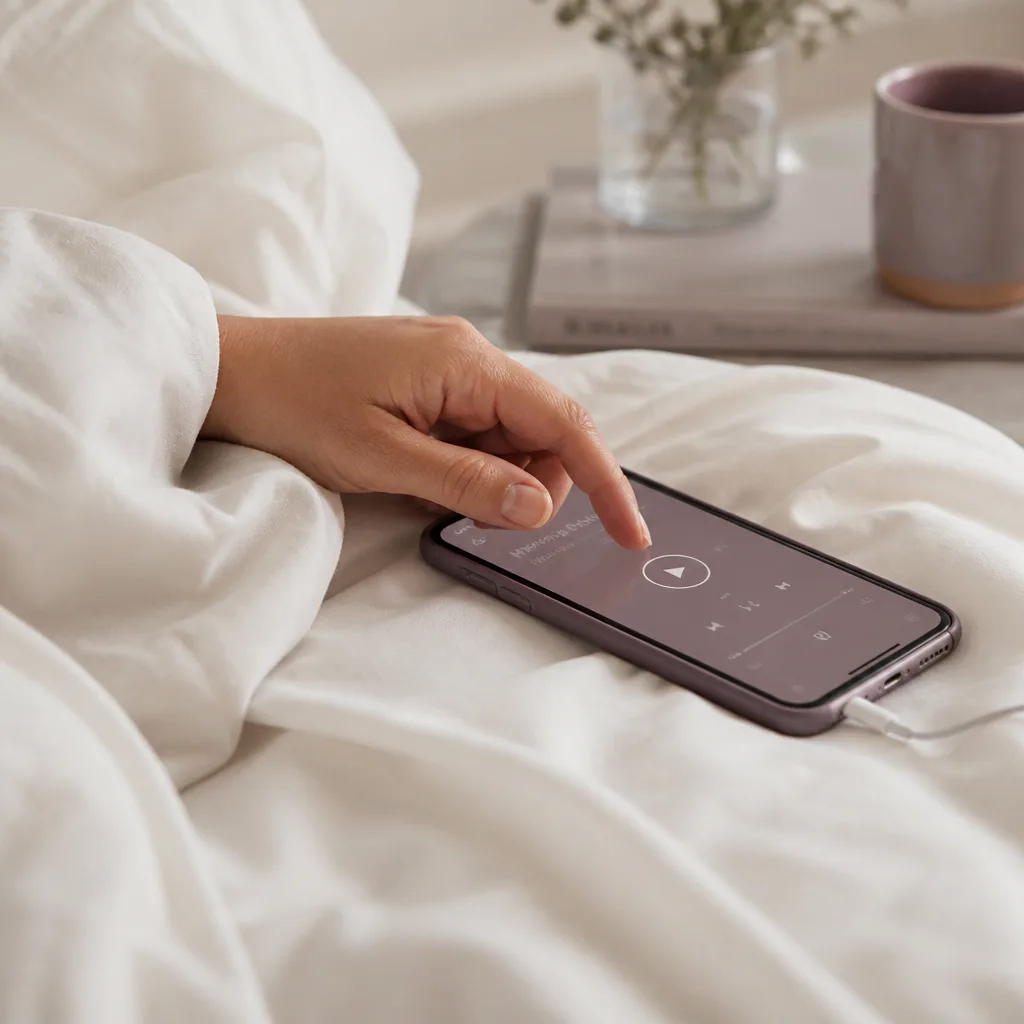
- Press play before opening anything else. No messages. No weather. No feed.
- Listen without fixing your thoughts. If your mind wanders, return to one line.
- Choose one visible action. Drink water. Write one sentence. Send the honest reply. Stand in sunlight for 2 minutes.
The visible action matters because manifestation can become vague if it never touches behavior. A 2010 review in Health Psychology Review on self-regulation noted that intention paired with planning is more likely to change action than intention alone. You are not proving your worth. You are giving your mind a next step it can see.
| Minute | What you do | Why it helps |
|---|---|---|
| 0:00 | Wake and pause | Breaks the reflex reach |
| 0:30 | Press play | Makes listening the first cue |
| 1:00-4:00 | Stay with the audio | Repeats the identity you are practicing |
| 4:00-5:00 | Choose one action | Turns the inner cue into a real gesture |
If you want language support later in the day, affirmations can be useful. But in this practice, they come after the audio. The first sound is the method. The sentence you repeat later is a complement.
A ritual becomes real when it survives an ordinary Tuesday.
What if you need your phone for the audio?
Use the phone as a doorway to the recording and nothing else.
This is the practical problem. The audio lives on the same object as the inbox, the group chat, the news, and the tiny red numbers. So you do not need a fantasy of perfect distance. You need friction. Behavioral design often uses friction to make one action easier and another harder. In small studies on digital habits, even a short delay before opening apps can reduce automatic checking for some users.
Set the phone up before bed. Put the audio on the first screen you see. If your app allows it, download the recording. Turn off nonessential notifications. Move social apps off the home screen. Use grayscale if it helps. A 2017 University of Texas study led by Adrian Ward found that the mere presence of a smartphone could reduce available cognitive capacity, even when the phone was not in use. Distance helps. So does intention.
Try this simple rule for 7 mornings: no open apps before the audio ends. If you must use the same phone, open only the player. Do not check the time more than once. Do not scan notifications. If you break the rule, return the next morning without making a trial out of it.
The practice is not purity. It is order.
You can also use physical cues:
- Put headphones on top of the phone.
- Leave a paper note that says, “listen first.”
- Charge the phone across the room.
- Use a basic alarm clock for 1 week.
- Keep a glass of water next to the bed as the first after-audio action.
If you use astrology and manifestation as a reflective tool, keep it later in the morning. Check transits after the listening, not before. First, hear the self you are practicing. Then let symbols, calendars, and sky language become mirrors rather than masters.
Where do affirmations and a Manifestation Board fit?
They fit after the listening, as supports, not as the center.
This is easy to confuse because visual and written tools are more visible than sound. A board can sit on a wall. A sentence can be copied into a notebook. Audio disappears as soon as it is heard. But the quietest practice may be the one that reaches you first. The Dream-Self Moment is not decoration. It is the daily contact point.
A daily affirmation can help you carry one phrase from the audio into the rest of the day. Keep it plain. One sentence. Not a performance. For example: “I keep one promise before I answer the world.” In a 2009 study in Psychological Science, researchers found that positive self-statements did not help everyone in the same way, especially when the statement felt too far from what the person believed. This is why true language matters.
A Manifestation Board can help you see the life you are practicing. It can hold images, words, rooms, textures, places, or reminders. But it should not become another place to compare yourself. If the board makes you feel behind, make it smaller. One image can be enough. The app may include these supports, but the center remains the audio.
For a wider frame, the Manifestation pillar explains the practice as attention, belief, and action working together over time. The morning version simply makes that frame very small. A few minutes. A voice. A choice.
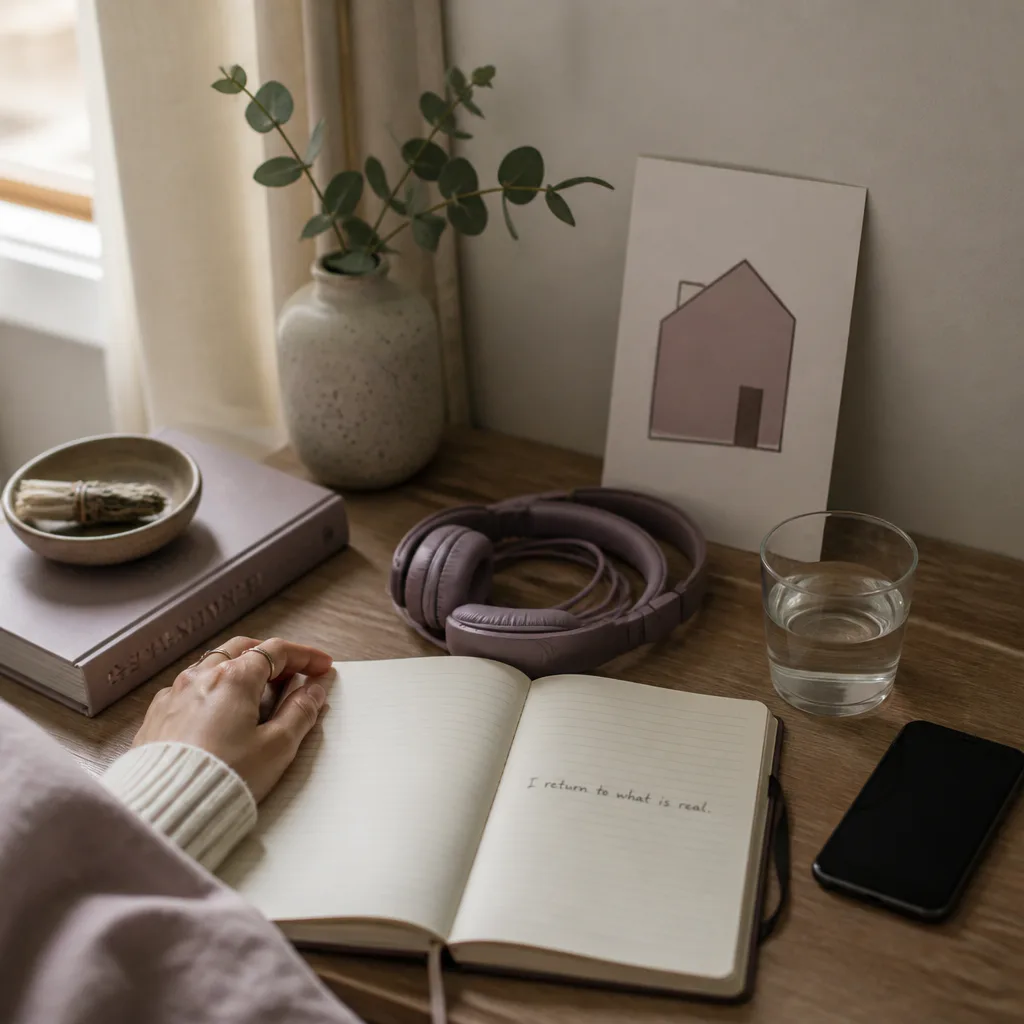
The board shows you where to look. The audio teaches you who is looking.
How do you know if the practice is working?
You know by watching what changes before noon.
Do not measure wake up manifestation only by whether a large desire arrives. That will make you impatient, and impatience is noisy. Watch for smaller evidence. Did you touch your phone later than usual? Did you answer the first message with less panic? Did you remember one line from the audio while making coffee? Did you choose the thing you said mattered?
Tracking helps because memory edits itself. For 7 days, write down 3 marks after the practice. Keep them simple:
- Time before phone: how many minutes before you opened messages or feeds.
- Line remembered: one phrase from the audio that stayed.
- Action taken: one small act that matched the self you heard.
Habit formation is slower and more varied than the old 21-day claim. A 2009 study by Phillippa Lally and colleagues in the European Journal of Social Psychology found that automaticity took an average of 66 days, with a wide range from 18 to 254 days depending on the behavior and person. So 7 days is not the finish. It is a first reading.
You may also notice resistance. That does not mean the practice is wrong. Resistance can mean the old morning pattern was doing something for you. It gave you a hit of certainty. It let you know what others wanted. It kept you from hearing yourself too soon. Be kind to that. Then press play again.
If you want to deepen the language you hear, revisit the AYA Method and refine the Dream-Self Moment so it sounds like your real future self, not a stranger with perfect lines. The more honest the audio, the easier it is to return.
What should you do tomorrow morning?
Set the practice tonight so tomorrow’s first choice is already waiting.
Before you sleep, choose the recording. Place the phone where you can reach it, but not by accident. Put headphones beside it. Write one paper note if you need to: “listen before touch.” The phrase is plain because the morning mind needs plain things. You are leaving a trail for yourself.
Then decide your one after-audio action. Make it visible and small. Not “become calm.” Try “drink water before email.” Not “change my life.” Try “write the one sentence I have been avoiding.” Specificity matters. In cognitive psychology, cue-based plans work partly because they reduce the number of decisions required in the moment. Fewer decisions means less room for the old reflex to take over.
You can use this 5-minute shape for the next week:
| Day | Audio | One action | Note |
|---|---|---|---|
| 1 | Dream-Self Moment | Water before messages | Notice the reach |
| 2 | Same audio | Stand by a window | Hear one line twice |
| 3 | Same audio | Write one sentence | Keep it small |
| 4 | Refined audio | Delay feeds 10 minutes | No drama |
| 5 | Same audio | Send one honest reply | Let it be enough |
| 6 | Same audio | Walk outside 3 minutes | Body first |
| 7 | Same audio | Review the 3 marks | See what changed |
This is not a contest against the phone. It is a return to the first voice you want to believe. One quiet practice, repeated, can become a room you know how to enter.
Leave the morning one true sound.
Listen on Aya
