morning rituals
Morning Meditation Routine After Snooze: 3 Minutes
A quiet morning meditation routine for the minutes after snooze: breathe, listen, choose one true sentence, and begin without rushing.
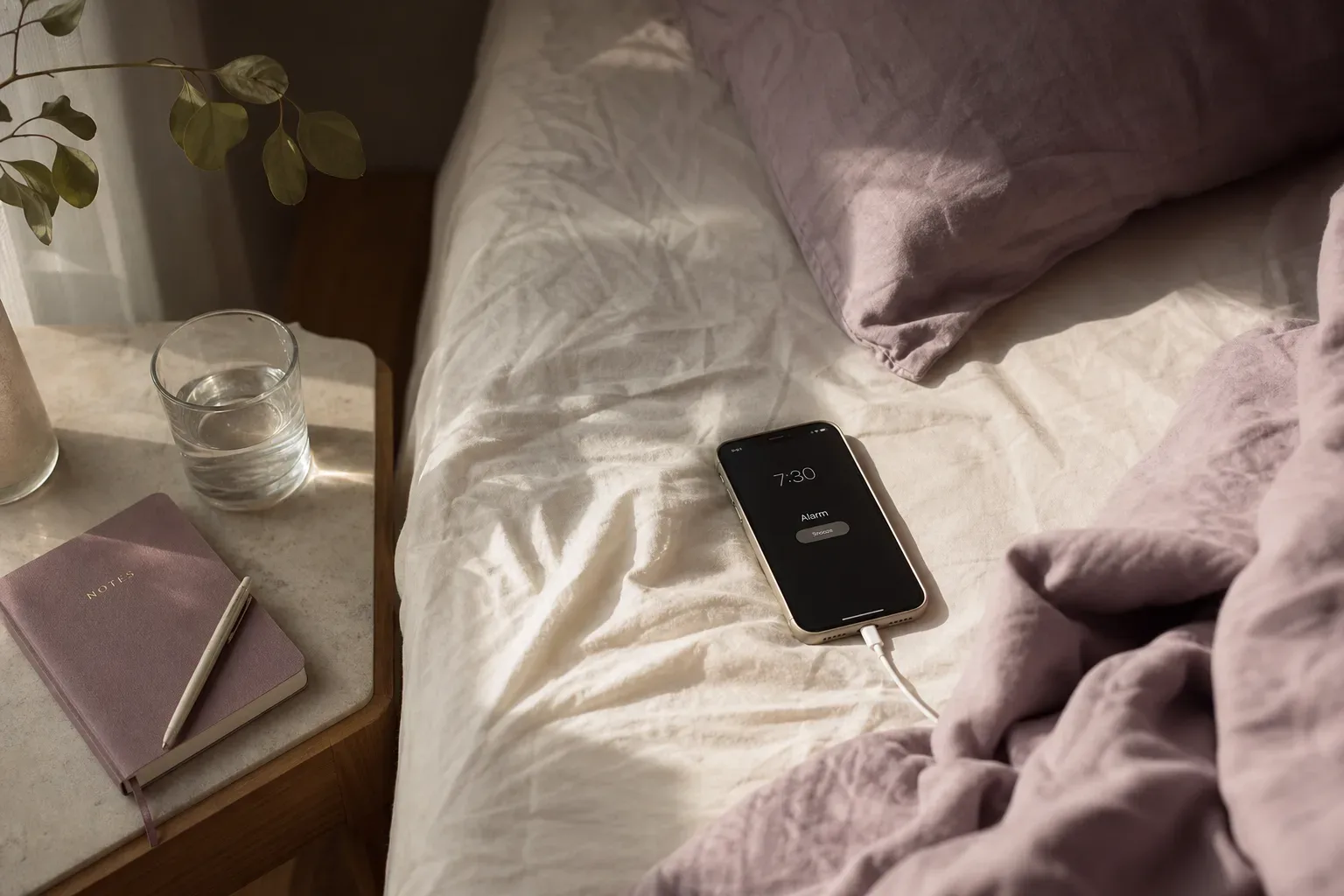
The phone is still warm in your hand. A morning meditation routine after snooze should be short, physical, and kind: one minute to breathe, one minute to listen, one minute to choose the first true action. Three minutes is enough when the practice is repeatable.
What can three minutes do after you hit snooze?
Three minutes can interrupt the half-awake argument and give your morning one steady cue.
The snooze button is not a moral failure. It is a button. Still, it has a cost. Sleep researchers have found that interrupted sleep can leave some people with more grogginess, a state often called sleep inertia, especially in the first 15 to 30 minutes after waking. A 2023 study in the Journal of Sleep Research found that many adults use snooze regularly, and the effect depends on timing, sleep debt, and how quickly the body is asked to perform.
So the question is not whether you should become a different person by tomorrow. The question is smaller. What can you do in the exact place where the morning keeps beginning?
A 3-minute practice works because it asks almost nothing from you. It uses the cue you already have: the alarm. BJ Fogg, who studies behavior design at Stanford, often teaches that tiny habits grow best when attached to an existing routine. The alarm is already reliable. Your willingness does not have to be.
Three minutes also respects attention. In a 2019 Pew Research Center report, many adults described checking phones soon after waking, and phone use has only become more common since then. If the first input is a message, a headline, or a calendar alert, your mind starts in response mode. Meditation gives you one quiet interval before the world starts making claims.
A small practice kept daily becomes more believable than a large practice kept rarely.
This routine is not here to make your morning beautiful. It is here to make it yours.
How do you set up the routine before you need it?
You set it up the night before so the morning version of you has fewer decisions to make.
Decision-making is expensive when you are sleepy. The American Academy of Sleep Medicine recommends adults get at least 7 hours of sleep per night, yet many people do not. When you wake short on sleep, even choosing a practice can feel like paperwork. So the routine should be prepared before the room goes dark.
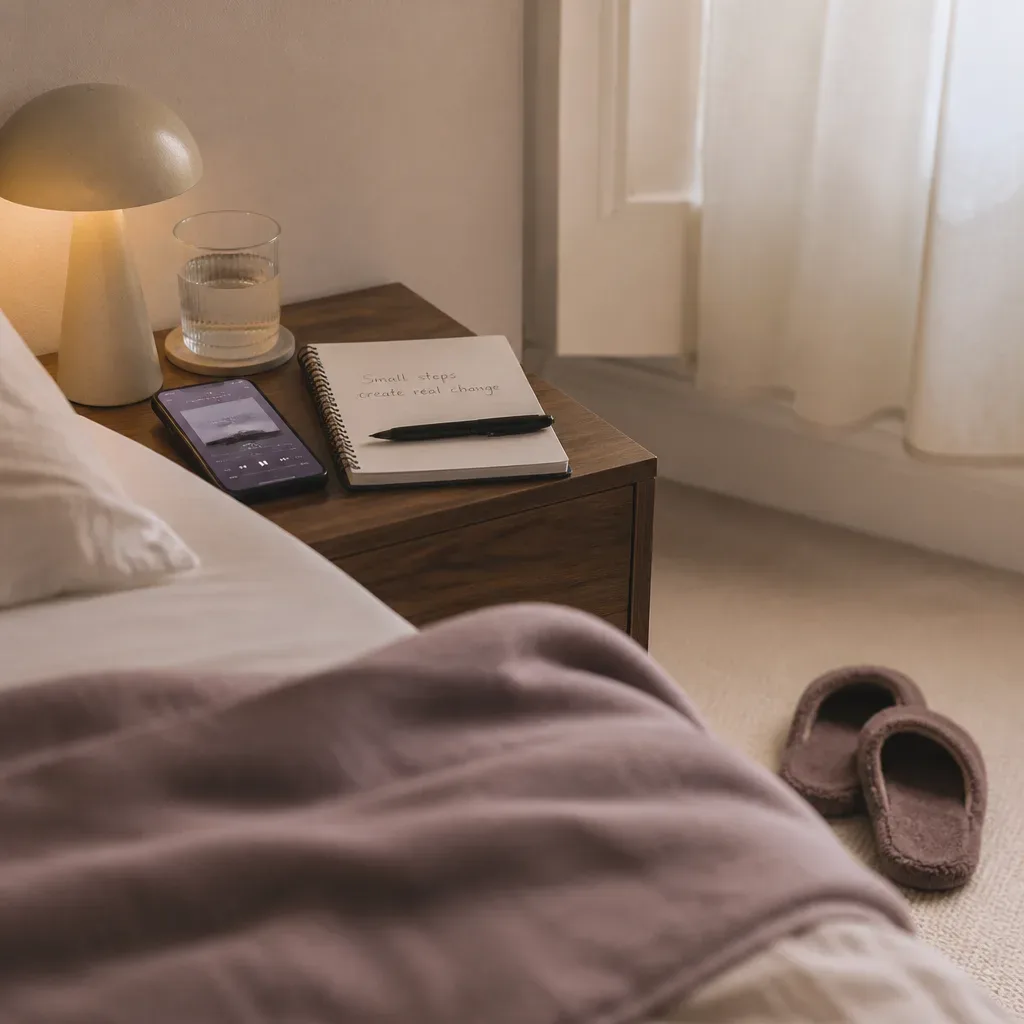
Put the phone or audio device within reach, but not inside the bed if that leads to scrolling. If you use an app, open the exact screen before sleep. If you keep a written sentence nearby, place the notebook open with a pen across the page. The goal is not discipline. The goal is removing one small friction point.
Try this setup for 7 mornings before judging it:
- Choose one alarm sound you do not hate.
- Put a glass of water within arm’s reach.
- Open your meditation audio or write one sentence on paper.
- Decide your first action after the practice: bathroom, curtains, kettle, shower.
- Place your feet on the floor when the second alarm ends.
There is a reason the list is plain. Plain survives sleepiness. Beautiful systems often collapse at 6:42 a.m.
You can also make a small rule: no reading messages before the three minutes are done. In attention research, task switching is associated with measurable costs. A widely cited 2001 paper by Rubinstein, Meyer, and Evans found that switching tasks can slow performance, especially when tasks are complex. Morning messages are not always complex, but your feelings about them may be.
The first win is not serenity. The first win is staying with yourself for 180 seconds.
What exactly do you do in minute one?
In minute one, you bring the body online before asking the mind to believe anything.
You may stay lying down. You may sit with your back against the headboard. If you know you will fall asleep again, put both feet on the floor. That single movement gives the nervous system a clearer message than a lecture ever could.
Use six slow breaths. Count them if counting helps. Inhale through the nose for about 3 or 4 seconds. Exhale for about 5 or 6 seconds. Longer exhales are often used in breathing practices because they can support parasympathetic activity, the branch of the autonomic nervous system associated with settling. In small studies on paced breathing, rates near 5 to 6 breaths per minute have been linked with improved heart rate variability, though individual responses vary.
Here is the minute:
- Breath 1: feel the sheet or blanket.
- Breath 2: notice the weight of your head.
- Breath 3: soften the jaw.
- Breath 4: drop the shoulders by 1 percent.
- Breath 5: feel both hands.
- Breath 6: say, silently, “I’m here.”
That is enough. You do not need to empty the mind. You are not a sink. Thoughts can remain; you simply stop serving each one breakfast.
If anxiety arrives quickly in the morning, keep your eyes open and name 3 visible things. This is a common grounding technique used in many therapy settings, including variations of the 5-4-3-2-1 method. It gives attention a place to land. The lamp. The door. The blue sock on the floor. The sock is not spiritual. It is useful.
The body believes repetition before it believes a speech.
Minute one is the hand on the door. Not the whole house.
What do you listen to in minute two?
In minute two, you listen to a short future-self audio or one present-tense sentence that feels true enough to repeat.
This is where the AYA Method can come in, quietly. The AYA Method is a daily audio manifestation practice. Each day you listen to a short personalized recording — your Dream-Self Moment — narrated from the version of you who has already manifested the life you intend. Listening is the practice. Repetition is the work. The audio is the method.
Audio matters because it reduces the work of generating words while sleepy. You press play. You receive the sentence. You let the voice carry the shape of the self you are practicing. If you are new to manifestation, think of it less as getting something from far away and more as rehearsing the identity that can meet what is already in front of you.
There is some science near this, though not all of it uses the same language. Mental rehearsal has been studied in sports psychology for decades. A well-known 1995 meta-analysis by Driskell, Copper, and Moran found that mental practice can improve performance, especially when paired with physical practice. Meditation research also suggests that brief daily practice can influence attention. A 2018 review in Behavioural Brain Research noted benefits of mindfulness training, while also warning that study quality varies.
Use this simple comparison if you are choosing between silence, audio, or a written line:
| Option | Best when | Watch for |
|---|---|---|
| Silence | You wake calm and clear | Drifting back to sleep |
| Audio | You need to be carried | Choosing tracks that are too long |
| Written sentence | You want one clean thought | Making it too grand |
A daily affirmation can support this minute, especially if it is plain. The affirmations guide may help you choose language that your nervous system does not reject. “I answer one important email before noon” may be better than a sentence your body hears as theater.
Manifestation becomes steadier when it stops trying to impress you.
If you only have one minute, choose the audio. Let the morning hear the self you are returning to.
What do you choose in minute three?
In minute three, you choose one action that can happen in the next 10 minutes.
The action should be small enough that the sleepy mind cannot build a courtroom around it. Not “fix my life.” Not “be a better person.” Choose something with a verb and a place: drink the water, open the curtains, put the notebook on the table, start the kettle, step into the shower.
Implementation intention research is useful here. Psychologist Peter Gollwitzer has shown across many studies that if-then plans can increase follow-through. A common form is: “If situation X happens, then I will do Y.” For this routine, the sentence is simple: “When the three minutes end, I put my feet on the floor and drink water.”
You can pair the action with one present-tense line:
- “I begin before I negotiate.”
- “I take the next kind step.”
- “I keep one promise this morning.”
- “I return to what is real.”
The line should not inflate the action. It should bless it. There is a difference.
This is also where a Manifestation Board can help later, as a complement rather than the center. The center is still the audio, the listening, the repeated Dream-Self Moment. A board gives the eyes something to recognize after the body has already begun. If symbols matter to you, astrology and manifestation can offer timing language, but the morning still asks for a human action: stand up, drink water, begin.
A 2010 study by Lally and colleagues in the European Journal of Social Psychology found that habit formation took an average of 66 days, with wide variation from person to person. That is good news. You do not need to decide your identity every morning. You can practice a cue until it starts deciding less painfully for you.

What if your mind is loud the second you wake?
If your mind is loud, make the routine more concrete and less verbal.
Some mornings arrive already full. Bills. Children. A message you should not have read last night. A sentence someone said in 2016. The mind can be a librarian with no closing hour. I say this as a librarian.
Do not try to win an argument with thought at 6 a.m. Use the room. Touch the wall. Put the heel of your hand against your sternum. Name the date. Name the city. Name the next ordinary thing. These are not decorations. They are anchors.
Clinical mindfulness programs often begin with body-based attention for a reason. Jon Kabat-Zinn’s Mindfulness-Based Stress Reduction program was originally structured as an 8-week intervention, and many later studies have examined its effects on stress, pain, and mood. Your 3-minute practice is not the same as an 8-week program. But it borrows one honest principle: return to direct sensation before chasing every thought.
Try this reset when the mind is sharp:
- Open your eyes.
- Press your feet or calves into the mattress.
- Exhale audibly once.
- Say, “Not everything needs me yet.”
- Play the audio or repeat your one sentence.
If the practice brings up sadness, let it be simple. One hand. One breath. One sentence. Meditation is not a way to become unavailable to pain. It is a way to stop letting pain hold the entire microphone.
You don’t need a quiet mind to begin. You need one quiet place to put your attention.
For more context on how intention, attention, and repetition fit together, the wider manifestation pillar is a useful next read. Read it later, though. Not before the three minutes.
How do you keep this routine without turning it into another task?
You keep it by making the measure small: did you return, not did you perform?
Track the routine for 14 days, but do not grade the mood. A check mark means you gave the practice 3 minutes. It does not mean you felt calm, pure, or wise. It does not mean the day went well. It means you returned.
A small paper tracker is often better than an elaborate app if apps lead you elsewhere. Put 14 tiny boxes on a card. Leave it beside the bed. Mark the box after the routine, not before. The brain likes visible evidence. In behavior research, immediate rewards and visible completion cues can help reinforce repetition, especially for new habits.
Here is a simple 2-week review:
| Day range | What to notice | What to change |
|---|---|---|
| Days 1-3 | Did you start at all? | Make it easier |
| Days 4-7 | Did you stay awake? | Sit up sooner |
| Days 8-10 | Did the sentence feel true? | Make it plainer |
| Days 11-14 | Did one action follow? | Choose a smaller action |
If you miss a day, do not write a speech about it. Restart the next morning. Habit researchers often note that one missed repetition matters less than the story you attach to it. The story “I failed” is heavy. The story “I return” is portable.
You may also want a weekly longer practice, perhaps 10 or 20 minutes, but let that be extra. The daily practice is the one that can survive laundry, late nights, weather, and your own very persuasive pillow.
The app may also include a daily affirmation and a Manifestation Board, and both can support the morning. Still, keep the order clear. Listen first. Let the audio name the self. Let the sentence and the image follow.
Your morning meditation routine does not need to become a new personality. It can remain small, almost hidden, and still change the first note of the day.
The room is waiting, and you are already here.