audio manifestation
Subliminal Manifestation vs Future-Self Audio
Subliminal manifestation hides the message. Future-self audio asks you to hear it, repeat it, and let your nervous system recognize it.

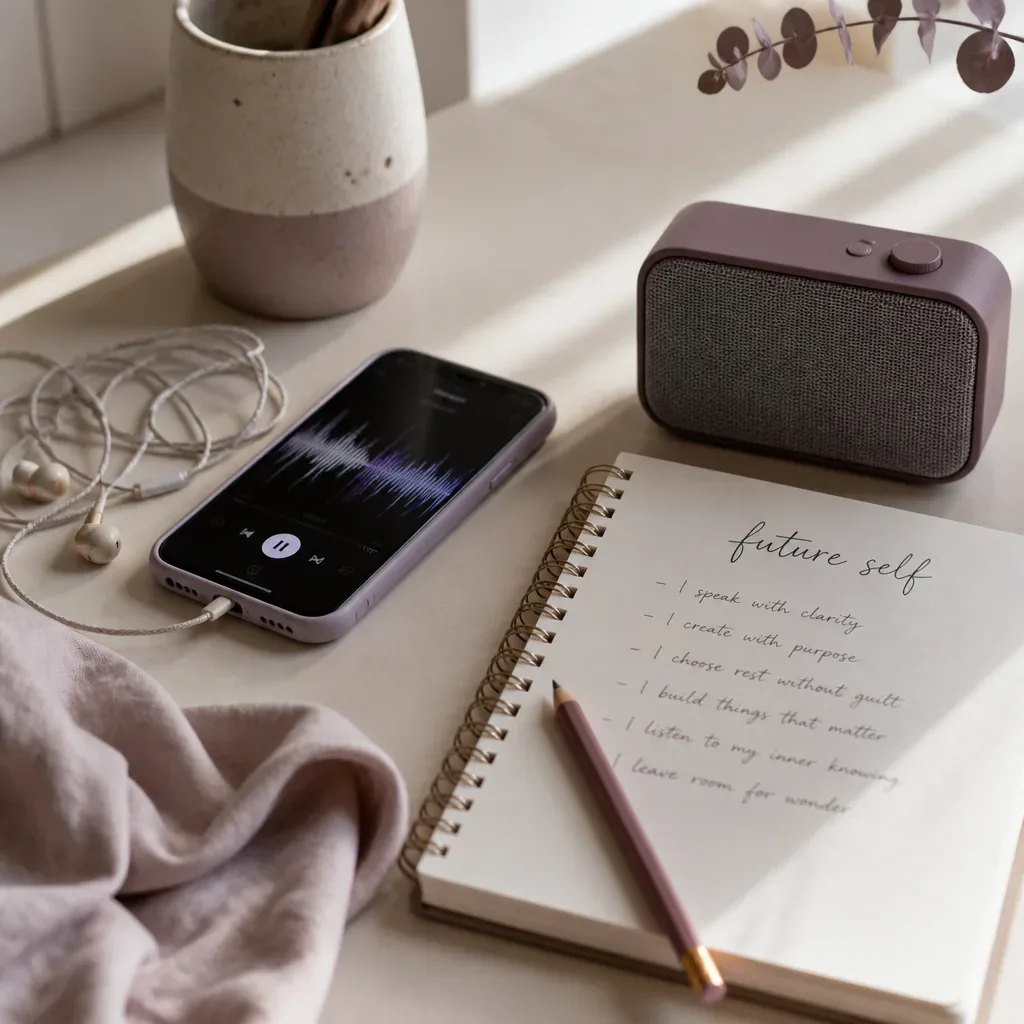
A cup cools beside the speaker. Subliminal manifestation hides suggestions below music or noise; future-self audio lets you hear the message clearly. If you want a practice you can consent to, remember, and repeat, conscious future-self audio is steadier. The difference is not volume. It is relationship.
What is subliminal manifestation actually asking you to trust?
Subliminal manifestation asks you to trust a message you cannot fully hear.
Most subliminal tracks place spoken suggestions beneath music, rain, tones, or layered sound. The promise is simple: your conscious mind rests, while the hidden message reaches something deeper. The idea is old. In 1957, market researcher James Vicary claimed that hidden cinema messages increased popcorn and Coca-Cola sales. He later admitted the study was not reliable, yet the story stayed. Some stories keep breathing after the evidence has gone quiet.
Research on subliminal perception is more careful now. In controlled psychology studies, subliminal priming can shift a choice or reaction time for a short period, often measured in milliseconds or minutes. A 2012 review in Neuroscience of Consciousness and related work on unconscious processing describe small effects under narrow conditions. Small is not nothing. But small is not the same as a life practice.
There is also the matter of consent. If you cannot hear the words, you cannot ask your body if they feel true. You cannot notice the phrase that tightens your jaw. You cannot soften a command into a sentence you can live with. A hidden message may bypass resistance, but resistance is sometimes information.
A practice that asks you not to listen is teaching you to leave yourself out.
This is where manifestation needs care. Manifestation is not pretending the world has no weight. It is the repeated act of becoming familiar with a chosen reality until your perception, speech, and action begin to match it. Familiarity needs contact. Contact needs some form of awareness.
Subliminal manifestation can feel soothing, especially when it is basically music with good intentions underneath. But soothing is not the same as conscious rehearsal. If the message matters, you deserve to hear it.
How does future-self audio differ from hidden affirmations?
Future-self audio differs because the message is audible, personal, and remembered by attention.
In the AYA Method, The AYA Method is a daily audio manifestation practice. Each day you listen to a short personalized recording — your Dream-Self Moment — narrated from the version of you who has already manifested the life you intend. Listening is the practice. Repetition is the work. The audio is the method.
That last sentence is the center. The audio is not background decoration. It is the room you enter for a few minutes. You hear your future self speak in the present tense. Not as a command. Not as a trick. As a remembered place.
Neuroscience gives a plain reason this matters. Dr. Andrew Huberman has often described attention as a gate for plasticity: the nervous system changes more readily around what it marks as relevant. In laboratory terms, attention influences learning through neuromodulators such as acetylcholine and dopamine. You do not need to make that mystical. A thing you consciously hear is easier to encode than a thing you cannot check.
There is also self-reference. A 2018 study in Social Cognitive and Affective Neuroscience found that self-referential processing recruits midline brain regions involved in personal meaning. When a message uses your life, your words, your future scene, it has more hooks. It can stay.
| Practice | What you hear | What you can edit | Main risk | Best use |
|---|---|---|---|---|
| Subliminal manifestation | Little or none | Often nothing | Hidden or generic scripts | Passive soothing |
| Spoken affirmations | Clear phrases | Usually yes | Mechanical repetition | Short daily cue |
| Future-self audio | A personal scene | Yes | Avoiding daily return | Conscious rehearsal |
Affirmations can be useful. One sentence can steady the day. But in AYA, the daily affirmation is a complement, not the method. The Manifestation Board can help you see it. Also a complement. The Dream-Self Moment is the practice because it gives the mind and body a full scene to hear again.
Which one is more supported by psychology?
Conscious future-self audio has stronger support from adjacent psychology than hidden manifestation tracks do.
There is no large clinical trial proving that personalized future-self audio creates a specific outcome. It would be dishonest to say there is. But several related research areas point toward why audible, self-relevant, repeated audio may be more useful than hidden suggestion.
First, mental rehearsal has evidence behind it. Sports psychology has studied imagery for decades. A 2017 meta-analysis in Psychology of Sport and Exercise found that imagery interventions can improve performance, especially when paired with physical practice. The effect is not magic. The brain rehearses sequences. The body learns cues. The person acts with more familiarity.
Second, implementation intentions are well supported. Psychologist Peter Gollwitzer’s work, including a 2006 meta-analysis with Paschal Sheeran covering 94 studies, found medium-to-large effects for if-then planning on goal achievement. Future-self audio is not the same as an if-then plan, but it can make the desired identity and next action easier to recognize. You hear the kind of person who does the thing. Then the day gives you a small test.
Third, self-efficacy matters. Albert Bandura’s social cognitive theory, developed across the 1970s and 1980s, showed that belief in one’s capacity changes persistence and behavior. Not fantasy belief. Credible belief. A hidden track saying you are unstoppable may not help if your system does not believe it. A future-self recording that names one honest scene may.
Here is a grounded way to compare the evidence:
- Subliminal priming can produce small, short-lived effects in controlled settings.
- Mental imagery can support performance when paired with practice.
- Repetition strengthens familiarity; a 2009 paper in the European Journal of Social Psychology found habit formation took a median of 66 days.
- Self-relevant language is easier to remember than generic language.
- Conscious listening lets you notice, revise, and return.
The mind is less defended when it is not being fooled.
This is not an argument against mystery. It is an argument for honesty inside mystery. You can keep the candle. You can keep the quiet. You do not have to hide the words.
What happens in the body when you listen consciously?
When you listen consciously, the body gets a chance to test the future for safety.
This matters because many people do not resist their desires. They resist the sensations that come with receiving them. A bigger life may bring pressure. Being seen may bring old memory. Having enough may bring grief for the years you did not. The nervous system does not move by slogan. It moves by repeated proof.
Dr. Stephen Porges’ polyvagal theory is debated in parts, but one useful clinical idea has spread widely: safety changes perception. When breath slows, muscle tone softens, and the voice feels steady, the body can take in information differently. Studies on paced breathing, including a 2017 review in Frontiers in Human Neuroscience, suggest slow breathing can influence autonomic regulation and emotional state.
This is where future-self audio has a quiet advantage. You can listen and notice. Does your chest close at a certain sentence? Does your mouth soften when you hear your own name? Does the imagined room feel too far away? That feedback is part of the practice. Clay tells the hand when it is too wet. The body tells the sentence when it is too false.
Subliminal manifestation gives you fewer signals. You may feel calm because the music is calm. You may fall asleep. That can be lovely. But it is hard to know whether the words are being integrated or simply passing under the floorboards.
A simple listening check helps:
- Can I hear every important sentence?
- Do I know who wrote or generated the script?
- Does the desire feel specific enough to recognize?
- Is there room for my body to say no?
- Can I repeat this daily for 30 days without forcing it?
Joe Dispenza’s work is often cited in manifestation circles for combining elevated emotion, future rehearsal, and repeated meditation. You do not have to accept every claim to see one useful thread: repetition plus feeling creates familiarity. Neville Goddard said it differently in the 20th century: assume the feeling of the wish fulfilled. The word that matters there is feeling. Feeling cannot be outsourced to a hidden track.
When might subliminal manifestation still be useful?
Subliminal manifestation may be useful as background support, not as the main practice.
There are nights when you are too tired for words. You want rain sounds. You want a voice almost below the edge. You want to be held by repetition without having to answer it. That is human. A subliminal track can serve as a soft container if you know what is in it and if it does not make extreme promises.
The safer version is transparent. Some creators publish the full script. Some use audible affirmations at a low volume rather than truly hidden messaging. Some specify frequency, length, and wording. If a track claims it will change your body, make someone love you, or guarantee wealth in 7 days, leave it. Certainty is often a sales voice wearing a spiritual coat.
Pew Research Center reported in 2023 that 27% of U.S. adults consider themselves spiritual but not religious. That leaves many people building private rituals from apps, videos, audio, and old books. Private rituals need discernment. No teacher is in the room with you. The track becomes the teacher.
If you use subliminal manifestation, use it like incense, not instruction. Let it mark a room. Do not let it replace the sentence you are brave enough to hear.
Here is a small boundary table:
| If the track says | Choose |
|---|---|
| Full script provided | Safer |
| No script, huge promises | No |
| Gentle sleep support | Maybe |
| Changes someone else’s will | No |
| Supports a conscious practice | Maybe |
You can pair background sound with astrology and manifestation if timing helps you pay attention. New moon, Sunday evening, after therapy, before the kiln opens. The timing is not the source. It is a bell. The listening is still yours.

How do you choose between the two without making it dramatic?
Choose the practice that gives you more agency, more clarity, and more return.
The question is not whether subliminal manifestation is good or bad. The better question is: what kind of relationship does this practice teach me to have with my own desire? If it teaches you to disappear, be careful. If it teaches you to listen, soften, and act, stay close.
Future-self audio is especially fitting when your desire needs embodiment. A new home. A calmer nervous system. A different way of receiving work. A relationship pattern that no longer repeats. These are not solved by a phrase hidden under ocean sounds. They ask for rehearsal. They ask for daily contact.
Behavior change research keeps returning to the same plain thing: repetition. The 66-day median from the 2009 habit study is not a rule, but it is a reminder that the body learns slowly. Many meditation studies use 8-week programs because two months is enough time to observe shifts in attention and stress for some people. Short daily practice beats rare intensity more often than the mind wants to admit.
A simple decision can help:
- If you need rest, use calming sound.
- If you need belief, use audible language.
- If you need a new self-concept, use future-self audio.
- If you need a cue during the day, use one clear affirmation.
- If you need to see the desire, use a board as support.
Notice the order. The audio leads. The daily affirmation and Manifestation Board can help, but they are not the pillars. In AYA, the Dream-Self Moment is the place you return to. You hear the future as if it is already speaking from inside the house.
A true practice does not need to sneak past you. It can knock softly and wait.
For a wider frame, you can read the manifestation pillar and the affirmations pillar. Both are useful when they stay honest. But if you are choosing one daily anchor, choose the one you can hear.
What would a conscious listening practice look like this week?
A conscious listening practice would be short, audible, personal, and repeated for seven days.
Seven days is not long enough to prove a life has changed. It is long enough to notice whether a practice makes you more present or more foggy. Keep it simple. Choose one time of day. Morning works for some. Night works for others. Research on habits suggests context stability matters; the same cue helps the brain remember the behavior.
Before you listen, take 3 slower breaths. Not perfect breaths. Just slower. Then press play. Let the Dream-Self Moment be the only task. If your mind argues, let it argue. If your body resists, listen to that too. Do not force belief. Forced belief is just fear with better lighting.
After listening, write one sentence. Not a page. One sentence is enough. It might be: I noticed my shoulders dropped. Or: I did not believe the part about being safe. Or: I know the blue door in that scene. Over 7 days, these notes become data. Soft data, yes. Still real.
If you also like subliminal tracks, place them after the conscious practice, not before. Let the audible message lead. Let the hidden or low-volume sound be atmosphere only. You can test this for one week without making it your identity.
Try this small structure:
- Day 1: Listen and note the sentence that feels most true.
- Day 2: Listen and note the sentence that feels least true.
- Day 3: Listen while seated, not multitasking.
- Day 4: Listen before one small action.
- Day 5: Listen and soften one phrase if needed.
- Day 6: Listen, then use one affirmation as a daytime cue.
- Day 7: Listen and decide what you want to repeat for 30 days.
The practice is not loud. It does not need to be. The self you are becoming is more likely to arrive through a sentence you can bear to hear, repeated until it feels like home.
Stay where you can hear yourself.
Listen on Aya

