evening rituals
Evening Routine After Work: Listen Before You Numb Out
Build an evening routine after work that uses one short audio practice before scrolling, snacking, or disappearing into the couch.
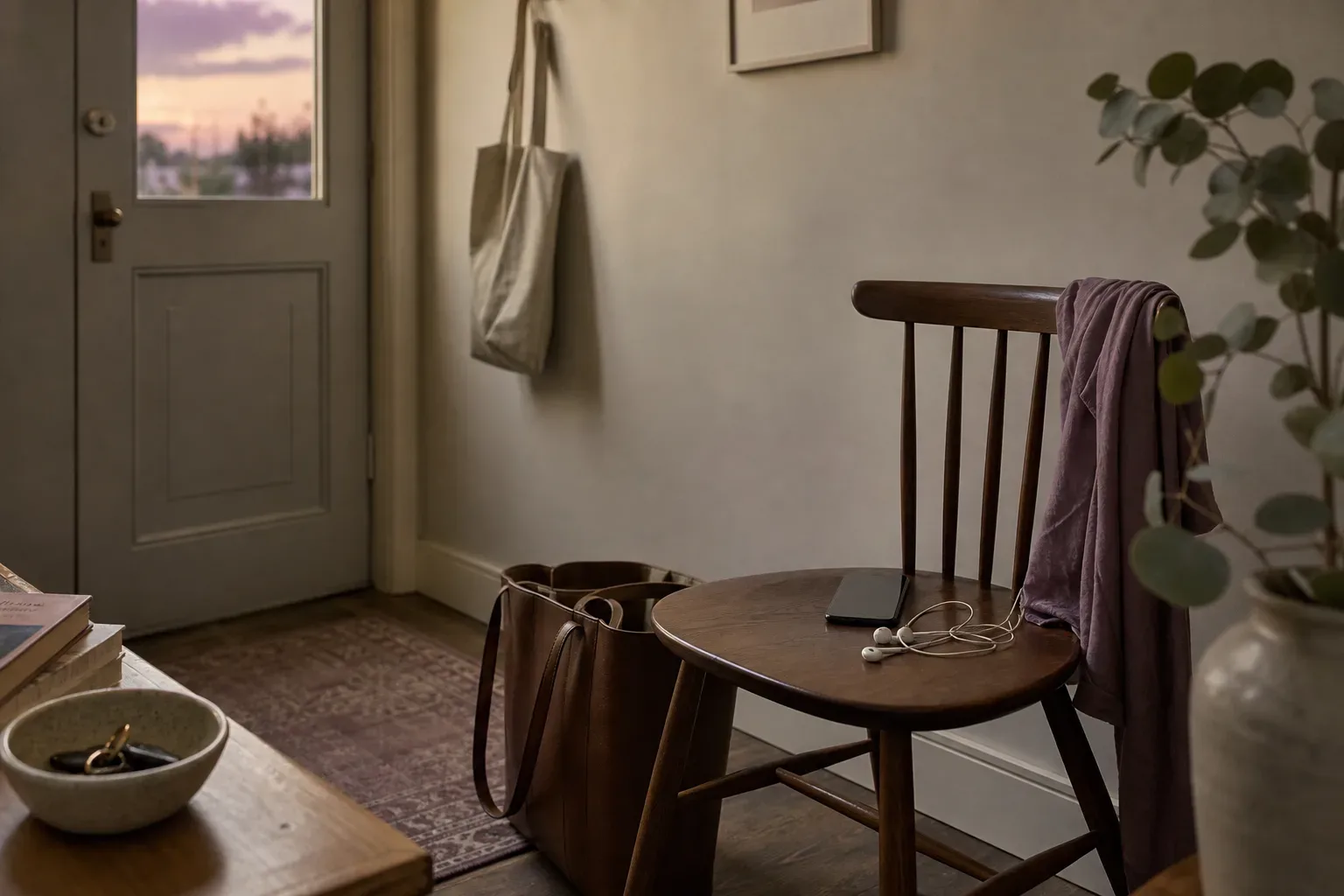
Your evening routine after work can be five quiet minutes: arrive, sit, listen, and then choose what comes next. The practice works best before the scroll, the snack, the drink, or the show. Not because comfort is wrong. Because the first choice teaches the rest of the night.
Why does the after-work window matter so much?
The after-work window matters because it is a daily threshold where stress often becomes habit before you notice.
You come in carrying the day on your face. Shoes half off. Phone already in your hand. This is the moment. Not a grand one. A small hinge. Behavioral scientists call this a cue-rich transition. In a 2009 University College London study by Phillippa Lally and colleagues, new habits took 66 days on average to feel automatic, and the cue was one of the main anchors. After work is already a cue. It is just waiting for instruction.
The body tends to seek quick regulation after effort. The American Psychological Association has reported for years that work is one of the most common sources of stress for adults in the United States, with money and health close behind. After 8 hours of being measured, interrupted, or needed, numbing can look like relief. Sometimes it is. But if it is the only doorway, the evening gets smaller.
A ritual does not need to fight the nervous system. It needs to meet it early. One glass of water. One chair. One recording. The practice is quiet enough to fit inside the real evening, the one with laundry and leftovers.
The first five minutes after work are not empty. They are a vote.
You are not trying to become a different person at 6:12 p.m. You are trying to keep one promise before the day takes the rest.
What should you do before you reach for the phone?
Before you reach for the phone, create a small physical sequence that tells your body work is finished and you are here.
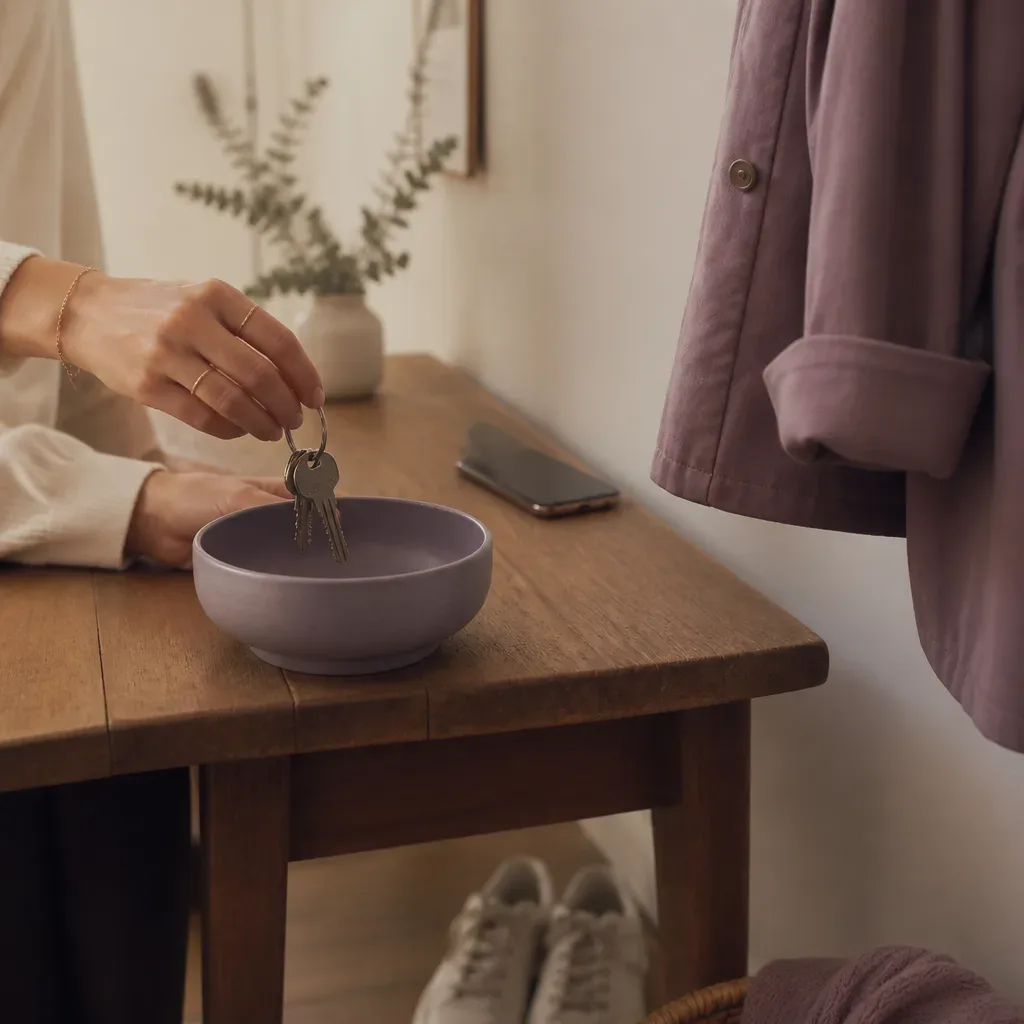
Use objects. They are kinder than willpower. Put your keys in the same bowl. Wash your hands for 20 seconds. Change one piece of clothing. Sit where you do not usually scroll. In habit research, context stability matters. Wendy Wood, a psychologist known for habit studies, has written that much daily behavior is guided by environment more than intention. The chair matters. The bowl matters. The charger across the room matters.
Try this numbered ritual for one week:
- Put your bag, laptop, or work badge away.
- Drink water before you open any app.
- Sit down with both feet on the floor.
- Take three slower breaths, about 5 seconds out each time.
- Press play on your audio before doing anything else.
This is not self-denial. It is sequencing. If you still want the show afterward, watch it. If you still want the snack, eat it sitting down. The ritual does not remove comfort. It places awareness before it.
Dr. Andrew Huberman often points to the role of visual attention and breath in shifting state, especially when the nervous system is charged. You do not need a 90-minute protocol here. You need 3 breaths and one clear next action. The threshold is narrow. That is why the practice must be simple.
You can make the phone part of the ritual only if it serves the listening. Open the app. Press play. Then turn the screen face down. A tool is still a tool when it is not allowed to become the room.
How does the AYA Method fit into an evening routine after work?
The AYA Method fits by making listening the center of the evening routine after work, not an extra task beside it.
The AYA Method is a daily audio manifestation practice. Each day you listen to a short personalized recording — your Dream-Self Moment — narrated from the version of you who has already manifested the life you intend. Listening is the practice. Repetition is the work. The audio is the method.
That definition matters. It keeps the ritual from becoming a pile of wellness chores. You are not building a shrine to self-improvement. You are listening to one short recording at the same point in the day, again and again, until the future self stops feeling like theatre and starts feeling familiar. Neville Goddard wrote often about assuming the feeling of the wish fulfilled. The audio gives that assumption a voice you can return to on ordinary evenings.
The app also includes a daily affirmation and a Manifestation Board. They are useful complements. They are not the pillars. If you use them after listening, let them be small. One sentence. One image. One remembered detail. The main act is still the Dream-Self Moment.
There is a reason audio is tender here. After work, reading can feel like effort. Visual boards can become another screen. Audio lets your eyes rest. A 2013 study led by David Creswell found that self-affirmation can reduce stress responses under pressure, especially when people reflect on core values. Listening to a future-self script is not the same study, but it touches a related pathway: identity, language, repetition, and stress.
A sentence can become a room if you hear it often enough.
What if you usually numb out because you are exhausted?
If you numb out because you are exhausted, do not shame the numbing; make the listening easier than the escape.
Exhaustion is not a character flaw. It is information. Gallup has reported that employee stress remains high globally, with recent State of the Global Workplace reports placing daily stress near record levels for many workers. When people are depleted, they choose the nearest relief. That is normal. So the ritual must be nearer.
Set the audio where your hand already goes. If your phone is the first object you touch, place the app on the first screen. If you always sit on the left end of the sofa, keep headphones there. If you drop everything by the door, put a small note there with one word: listen. The easier path wins more often than the nobler one.
Here is the honest table I use with clients and clay students alike:
| After-work state | Old pattern | Quiet replacement |
|---|---|---|
| Wired | Scroll for 40 minutes | Listen for 5, then choose |
| Flat | Collapse with a show | Listen lying down, eyes closed |
| Hungry | Snack standing up | Drink water, listen, then eat |
| Irritated | Replay the day | Listen before telling the story |
| Lonely | Message anyone | Listen, then send one true text |
Do not make the ritual dependent on feeling inspired. Lally’s 2009 habit study also found that missing one opportunity did not erase progress. This is kind. If you forget on Tuesday, you return on Wednesday. Clay dries in its own time. So do people.
A practice you can do while tired is more trustworthy than a practice that requires a better mood.
Can affirmations, astrology, or a board help without taking over?
Yes, supporting tools can help when they stay in their place and do not replace the listening.
After your Dream-Self Moment, an affirmation can name what you want to carry into the evening. Keep it plain. The affirmations guide is useful here because it treats affirmations as language you repeat until it becomes easier to choose, not as magic words. Write one line like: I come home to myself before I disappear. Or: I can rest without abandoning what is true.
A Manifestation Board can also help if you use it as a visual memory, not a demand. Look for 30 seconds. Then stop. The mind does not need 60 images after a long workday. It needs one true signal. Research on mental imagery in sport and rehabilitation has shown that repeated imagery can influence motivation and motor planning, though results vary by person and practice type. Use that modestly. A picture is a reminder, not a receipt.
Some readers also time evening rituals with moon phases or personal cycles. If that language is yours, keep it grounded. The astrology and manifestation piece can help you use timing as reflection rather than outsourcing your agency. A Friday ritual may feel different from a Monday one. A new moon may give you a clean page. Still, the work is the same: listen, repeat, return.
For broader context, the manifestation pillar explains why intention needs practice, not just desire. After work, desire is often tired. Practice can carry what desire drops.
How do you make the ritual last for 30 days?
You make the ritual last for 30 days by tracking completion, lowering the bar, and protecting the same cue each evening.
Thirty days is not a mystical number. It is a container. It is long enough to see patterns and short enough not to feel like a life sentence. In the Lally study, 66 days was the average for automaticity, but the range was wide: 18 to 254 days. So 30 days is not a finish line. It is a kiln shelf. You place the work there and see what the firing reveals.
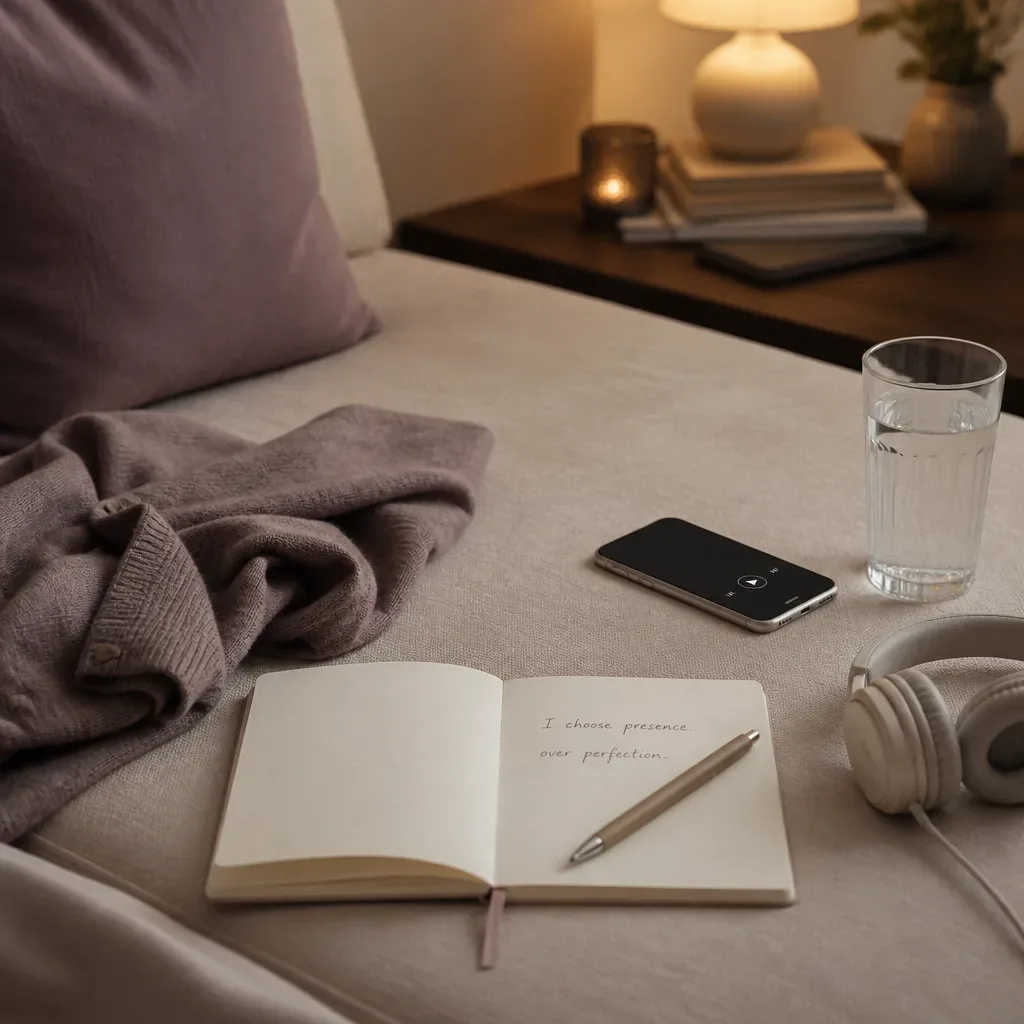
Use a tracker that takes less than 10 seconds. A dot on a calendar. A line in a notebook. A small mark in your notes app. Do not rate the ritual. Do not score your mood. Mark only this: did I listen before I numbed out?
Here are the rules I would give you:
- Keep the practice between 5 and 7 minutes.
- Use the same cue at least 5 evenings a week.
- Never make up missed days with double sessions.
- Let the daily affirmation be one sentence only.
- Review the Manifestation Board no more than 1 minute after listening.
- If you resist, make the ritual smaller, not more dramatic.
The the AYA Method page gives the larger frame if you want it, but the evening version is beautifully spare. Come home. Sit down. Listen. Then let the rest of the night be human.
A 2022 Pew Research Center survey found that many adults feel their phones take attention they did not mean to give. You may know this without a survey. The thumb moves before the self has arrived. That is why the ritual belongs before the feed.
What should the whole after-work ritual look like tonight?
Tonight, the whole ritual should look ordinary enough that you can do it without preparing your life first.
Here is a 7-minute version. At minute 0, cross the threshold and put your work object away. At minute 1, wash your hands or drink water. At minute 2, sit down and place both feet on the floor. At minutes 2 through 6, listen to your Dream-Self Moment. At minute 6, write one sentence or say it once. At minute 7, choose your next act with more care than speed.
That is all. If dinner needs to happen, make dinner. If children are calling, answer them. If you need to cry, cry. The ritual is not meant to make the evening clean. It is meant to help you enter it awake.
You can keep one backup version for hard days: stand by the sink, press play, and listen while water runs over a cup. Occupational health researchers often note that recovery after work depends on psychological detachment, relaxation, mastery, and control. The ritual touches at least two of those: you detach from work and reclaim one small act of control.
The quiet test is not whether you feel changed tonight. It is whether you know what you reached for first. If the first thing is listening, the evening has a different beginning.
Put the keys down. Let the room receive you.
Listen on Aya

