audio manifestation
Future Self Script for Audio: What to Say in 3 Minutes
Write a future self script for a 3-minute audio: simple structure, exact lines, timing, and quiet prompts for recording what you want to remember.
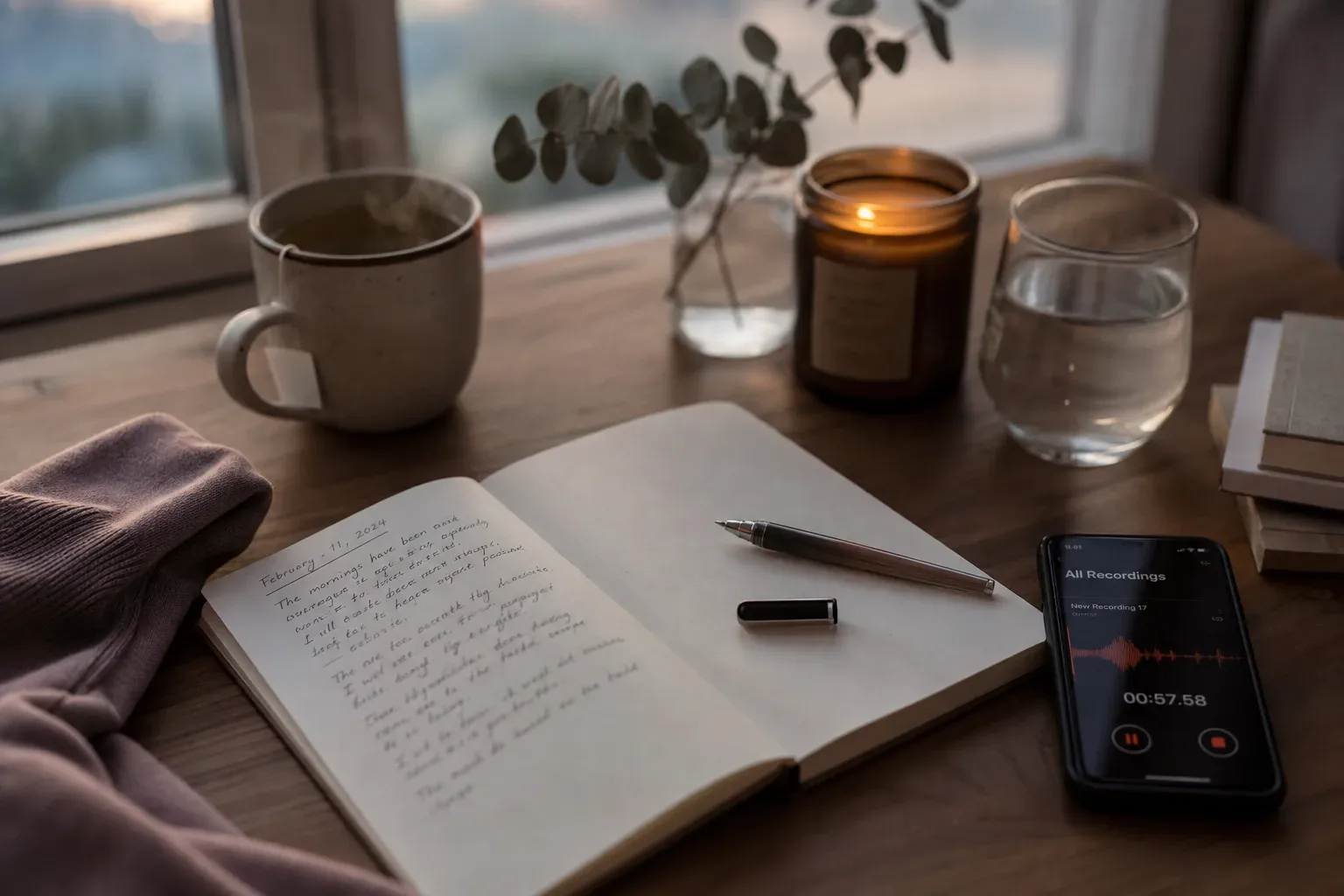
A future self script for audio should say what your future self already knows, in present tense, for about 390 to 450 words. Use one clear scene, ordinary proof, one felt truth, and one next action. Three minutes is enough when the recording is specific, repeatable, and easy to hear again.
What is a future self script supposed to do?
A future self script gives your mind a clear, repeatable picture of the self you’re practicing being.
Not a speech. Not a performance. A script is a small room you can enter again. If it’s for audio, it has one job: to become familiar in your own ear. The words should sound like you on a truthful day, not like a poster on a wall.
For a 3-minute recording, the script needs shape. At an average speaking pace of 130 to 150 words per minute, 3 minutes gives you about 390 to 450 words. That’s not much. Good. A small script asks you to choose. What matters enough to hear every morning?
The most useful future self script does 4 things:
- Names the future as already here.
- Shows evidence from daily life.
- Gives the body a feeling it can recognize.
- Returns you to one small action today.
This is close to the “best possible self” writing used in research by Laura King in 2001, where participants wrote about a personally meaningful future for 20 minutes across several days. Studies on that practice are mixed in size, but many show improvements in mood and goal clarity. Your audio version is shorter. It trades length for repetition.
A future self script is not a demand. It’s a rehearsal of recognition. You’re not trying to force belief. You’re giving yourself language quiet enough to come back to.
The right script doesn’t shout at doubt. It gives doubt somewhere softer to sit.
If you already practice manifestation, think of the script as the spoken form of your intention. It doesn’t replace action. It prepares you to see the next action without flinching.
How do you choose the one moment to write from?
Choose one ordinary future moment that proves the change has become normal.
This is where many scripts become too large. “My dream life” is too wide for 3 minutes. “I’m standing at the kitchen sink after sending the email I used to avoid” is usable. Your nervous system understands a sink. It understands a bus stop. It understands opening a calendar and not panicking.
Specific scenes work because the brain handles concrete cues better than vague declarations. In behavior research, implementation intentions are often written as “If X happens, then I will do Y.” Psychologist Peter Gollwitzer’s work, cited across more than 90 studies in a 2006 meta-analysis, found medium-to-large effects for this kind of cue-based planning. You’re doing something related here. You’re giving the future a cue.
Try this small selection test:
- Pick one area: work, love, money, health, creative life, home.
- Ask, “What would be different on a normal Tuesday?”
- Choose one visible scene from that Tuesday.
- Remove anything that sounds borrowed.
- Keep the detail that makes you breathe out.
A future self script gets stronger when it becomes less impressive. “I check my account and I don’t brace myself” may be more useful than “I’m financially free.” One is embodied. One floats away.
Here’s a quiet table for choosing your scene:
| If your intention is | Write from this kind of moment | Avoid this kind of line |
|---|---|---|
| Steadier money | Paying a bill without dread | “Money comes to me endlessly” |
| Creative consistency | Finishing one page before work | “I’m a famous artist” |
| Better love | Speaking honestly at dinner | “Everyone adores me” |
| Healthier rhythm | Walking after lunch three days a week | “My body is perfect” |
Three minutes can hold one room. Let it hold one room well.
What should the 3-minute structure include?
A 3-minute future self script should include arrival, identity, evidence, feeling, and one next action.
Think of it like shelving books. Each line needs a place. If the script wanders, the recording becomes hard to listen to daily. A simple structure helps you write once and repeat often.
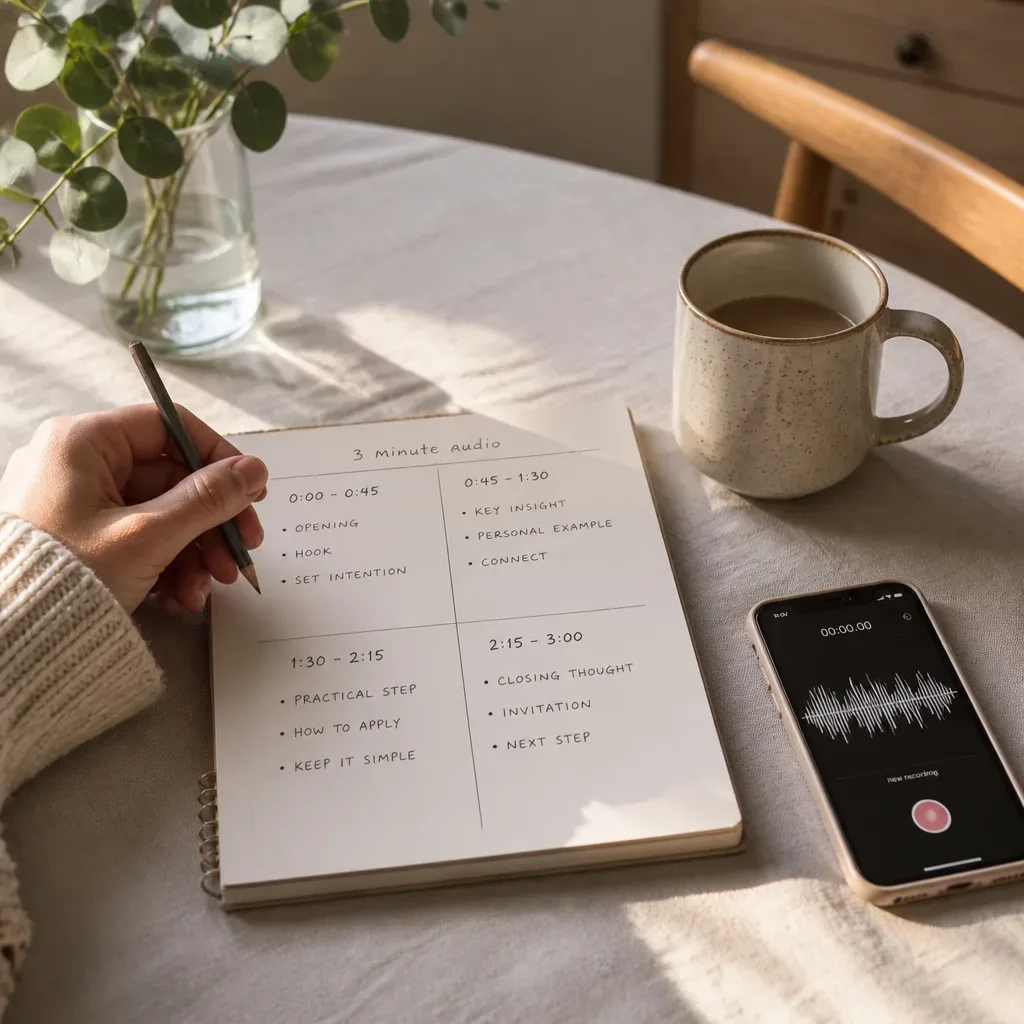
Use this timing:
- 0:00 to 0:30 — Arrive in the scene. Say where you are, what time it is, and what small detail tells you this future is real.
- 0:30 to 1:30 — Name who you are now. Speak from the identity that already lives this way.
- 1:30 to 2:30 — Show evidence. Mention 2 or 3 ordinary actions that prove the change.
- 2:30 to 3:00 — Return to today. Give yourself one simple action to take after listening.
This structure keeps the script near 400 words. If your recording runs longer than 3 minutes 30 seconds, cut it. Habit research is unglamorous and useful here. Lally and colleagues, in a 2009 study in the European Journal of Social Psychology, found an average of 66 days for a new behavior to feel automatic, with a wide range from 18 to 254 days. A short recording has a better chance of being repeated long enough to matter.
Here is the shape in plain language:
“I’m here now. This is what my life looks like. This is how I move. I can see the proof. Today I only need to do this next small thing.”
That’s the whole architecture. Small enough to remember. Clear enough to record.
If you use the AYA Method, the script becomes especially close to the heart of the practice. The AYA Method is a daily audio manifestation practice. Each day you listen to a short personalized recording — your Dream-Self Moment — narrated from the version of you who has already manifested the life you intend. Listening is the practice. Repetition is the work. The audio is the method.
A daily affirmation can sit beside this, and a Manifestation Board can help you see the theme. But the audio is the method. The words matter because you will hear them again tomorrow.
What exact words can you say in the recording?
Use simple first-person sentences that sound like your future self speaking after the change has settled.
Start with “I am” only when it feels true enough to hear. You can also begin with “I know,” “I notice,” “I remember,” or “I move.” These phrases are less brittle. They don’t require a theatrical voice. They let the future self sound like someone who has washed a cup and answered an email.
Here is a full 3-minute future self script you can adapt:
I’m standing in my kitchen in the soft part of the morning. The light is still low. My phone is not the first thing I reach for. I can feel how much has changed because my body is not waiting for bad news.
I know who I am now. I’m someone who keeps promises in small, real ways. I don’t need to prove my life all at once. I return to what matters, and I return again when I forget.
My days have more room in them because I’ve stopped abandoning myself at the first sign of discomfort. I answer the message. I open the document. I take the walk. I tell the truth sooner. None of this looks dramatic from the outside. That’s how I know it’s real.
I remember when this felt far away. I was waiting to feel ready. Now I know readiness often arrives after the first quiet action. I trust the small repeatable thing.
Today, I only need to take one step that belongs to this life. I don’t need to fix the whole pattern. I need to act like someone who already knows she’s safe to begin.
I’m here. I’m listening. I’m becoming familiar to myself.
That script is about 250 words, which may record at 2 minutes if you read quickly. Add silence. Silence counts. Dr. Andrew Huberman often notes in public teaching that slower breathing and longer exhales can shift arousal through the autonomic nervous system; formal breathing studies vary, but even 5 minutes of slow breathing has shown measurable effects on stress markers in small trials.
The script doesn’t need grand language. It needs usable language. If a sentence makes you tense, soften it. “I’m always confident” may be too far. “I can stay with myself for the next 10 minutes” may be true enough to build on.
For more on the difference between spoken identity and repeated lines, see the affirmations guide. Affirmations can help. But in audio scripting, context gives the affirmation a home.
How do you make the script believable without making it small?
Make it believable by choosing honest evidence, not by shrinking the desire.
There’s a difference. A believable script can still be brave. It just doesn’t lie about your body’s reaction. If your whole system rejects a line, you won’t listen for 66 days. You’ll avoid the audio by Wednesday. I’ve seen library books fail the same way. The ambitious ones come back crisp. The small useful ones come back with bent corners.
Use bridge sentences when the future feels too far:
- “I’m learning to recognize this as mine.”
- “I can feel the first signs of trust returning.”
- “I no longer confuse fear with instruction.”
- “I know what the next 10 minutes ask of me.”
- “I let this become normal slowly.”
Bridge sentences are not weaker. They’re kinder and often more repeatable. In clinical psychology, graded exposure works partly because the step is sized to the person’s current capacity. The same principle applies here. A script that can be heard daily will do more than a script that sounds perfect once.
A 2022 Pew Research Center report found that about 27 percent of U.S. adults said they used some form of meditation, yoga, or spiritual practice in recent years, depending on category and wording. The common thread is not spectacle. It’s repetition. Quiet practices survive because they fit inside real days.
You can also use sensory proof. The cup in your hand. The folder named correctly. The clean shirt on the chair. The calendar with white space. Sensory proof gives the future somewhere to land.
Your future self script should feel less like a wish and more like a memory your body is learning to keep.
If you like symbolic timing, you may also enjoy astrology and manifestation. Just remember: timing can support the practice, but it doesn’t replace the daily listen.

How should you record and listen to it?
Record slowly, in your own voice if you can, then listen at the same small cue each day.
You don’t need studio sound. A phone voice memo is enough. Choose a quiet room, turn off notifications, and read as if you’re speaking to someone you don’t want to startle. Keep your mouth a little farther from the microphone than you think. Six to eight inches is often enough to reduce breath noise.
Before recording, mark pauses with line breaks. If one sentence keeps tripping you, rewrite it. The ear is a good editor. It hears what the eye forgives.
Try this recording checklist:
- Length: 3 minutes, give or take 30 seconds.
- Word count: 390 to 450 words if you read at a natural pace.
- Tone: low, steady, unforced.
- Setting: one quiet place, no multitasking while recording.
- File name: something plain, such as “Future Self Morning 01.”
Listening is where the script becomes a practice. In the AYA Method, the Dream-Self Moment is designed for this daily return. You listen to the future self voice again and again until it becomes less strange. Not because sound is magic. Because repetition teaches recognition.
Neuroscience research on mental rehearsal is broad, and the details are often overstated online. Still, studies of imagery in sport and rehabilitation have found that rehearsed action can engage some overlapping neural networks with physical action. A well-known 1995 piano study by Pascual-Leone and colleagues found brain map changes after mental practice, though the study was small. The honest takeaway is simple: the brain responds to repeated rehearsal, especially when it’s paired with behavior.
So pair the audio with one action. After listening, send the email. Open the note. Drink the water. Put on the shoes. The recording is the room. The action is the door handle.
What mistakes make a future self script harder to use?
The biggest mistakes are writing too broadly, using words you don’t believe, and forgetting the next action.
A future self script can fail quietly. It may sound beautiful and still be impossible to repeat. The test is not, “Does this impress me?” The test is, “Would I listen to this on a tired morning?”
Watch for these common problems:
- Too many futures in one script. One recording tries to cover money, body, love, work, family, and purpose. The mind gets no clear image.
- No ordinary proof. The script says everything changed but shows nothing specific.
- Borrowed language. The lines sound like someone else’s social caption.
- No pause. The audio rushes, so the body never catches up.
- No action after listening. The script stays in the air instead of touching the day.
One statistic helps here: attention is costly. A 2010 study by Killingsworth and Gilbert in Science used experience sampling and found people’s minds wandered about 47 percent of the time. You don’t need to shame that. You need to write for it. Clear scenes. Short lines. Repeated cues.
If your attention wanders during the audio, shorten it before you blame yourself. A 2-minute recording you hear daily is better than a 9-minute recording you avoid. The practice that gets finished is the one that gets to change you.
You can keep a small note after listening. One sentence only: “Today I did the next true thing by ___.” Over 30 days, those sentences become evidence. Not fantasy. Evidence.
For a broader frame, return to the manifestation pillar and the audio-centered guide to the AYA Method. The script is not a charm. It’s a way of hearing the self you’re choosing, then moving like you remember.
Speak softly enough that tomorrow’s you will want to listen.