manifestation 101
How to Manifest: A Simple Step-by-Step Guide
Learn how to manifest with a quiet beginner practice: choose one desire, feel it as real, listen daily, act gently, and notice evidence.

Your notebook is open. The room is not asking for drama. To learn how to manifest, choose one clear desire, feel it as already true for a few minutes each day, repeat the same inner scene, take one matching action, and track evidence for 30 days.
What does it mean to manifest something?
To manifest is to practice a desired reality until your attention, choices, and body begin to recognize it as possible and then familiar.
The word can sound larger than it needs to be. At its simplest, manifestation is directed rehearsal. You decide what you want. You give it a specific inner form. You return to it often enough that your mind starts noticing openings, patterns, and actions that match it. The Manifestation pillar gives the wider map, but the beginner practice can stay small.
Neville Goddard called this living from the wish fulfilled. Joe Dispenza often describes rehearsing a future state until the body stops treating the old self as the only known self. You do not have to adopt every claim from either teacher to use the practical center: repeated attention changes what you notice and what you choose. Cognitive psychology has studied attentional bias for decades; what you repeatedly look for becomes easier to detect.
Manifestation is not a bargain with the sky. It is a daily vote for a version of you that you are willing to meet in behavior. That sentence matters because it keeps the practice honest. If you are manifesting steadier work, but never open the application, the practice has no doorway. If you are manifesting love, but keep choosing silence where truth is needed, the room stays unchanged.
A simple beginner definition helps:
- Desire: the thing you are choosing.
- Scene: the small moment that proves it is already real.
- Repetition: the return to that scene each day.
- Action: the ordinary step that belongs to it.
- Evidence: the signs that your attention and choices are changing.
In a 2019 Pew Research Center report, 62% of U.S. adults said they hold at least one New Age belief, such as spiritual presence in nature or reincarnation. The numbers vary by belief, but they show something plain: many people already sense that inner life and outer life speak to each other. Your task is to make that relationship clean, grounded, and yours.
The future does not need noise to become real. It needs a place to be practiced.
How do you choose what to manifest first?
Choose one desire that is emotionally true, specific enough to feel, and simple enough to practice every day for 30 days.
Beginners often choose too much at once. A new job, new body, new love, new home, new income, new confidence, all on one page. I understand this. As a former architect, I have seen people ask one room to solve the whole house. It cannot. A room teaches one main thing first: rest, work, welcome, repair. Your manifestation practice should do the same.
Start with one desire. Not because you are small. Because attention has a load-bearing limit. Research on working memory often points to a narrow capacity, commonly discussed as about 4 chunks of information in modern cognitive science, rather than the older 7-item rule. When your practice has one clear center, your mind can return without sorting a crowd.
Use this filter:
- Is it yours? Not borrowed from a parent, partner, feed, or old wound.
- Can you name it in one sentence? If not, keep simplifying.
- Would there be a clear sign it happened? You need recognition.
- Can you take one small action toward it this week? The body must be included.
- Does it feel quietly true, even if it feels far away? Truth may be soft, not loud.
Here is the difference between a vague desire and a usable one:
| Vague desire | Usable desire |
|---|---|
| I want a better life | I want calm, paid work that uses my design skill |
| I want love | I want a kind, mutual relationship where truth is safe |
| I want money | I want to earn $5,000 monthly from steady clients |
| I want confidence | I want to speak clearly in weekly meetings |
A number can help when it is relevant. If you want income, write the amount. If you want time, write the hours. If you want a home, write the city or qualities you need. Specificity is not control. It is a room with walls. Walls let you know where you are.
If the desire brings panic, make it smaller. Manifest the next honest threshold: one interview, one client, one conversation, one week of sleep. Small is not lesser. Small is where the nervous system can consent.
What is the simplest step-by-step way to manifest?
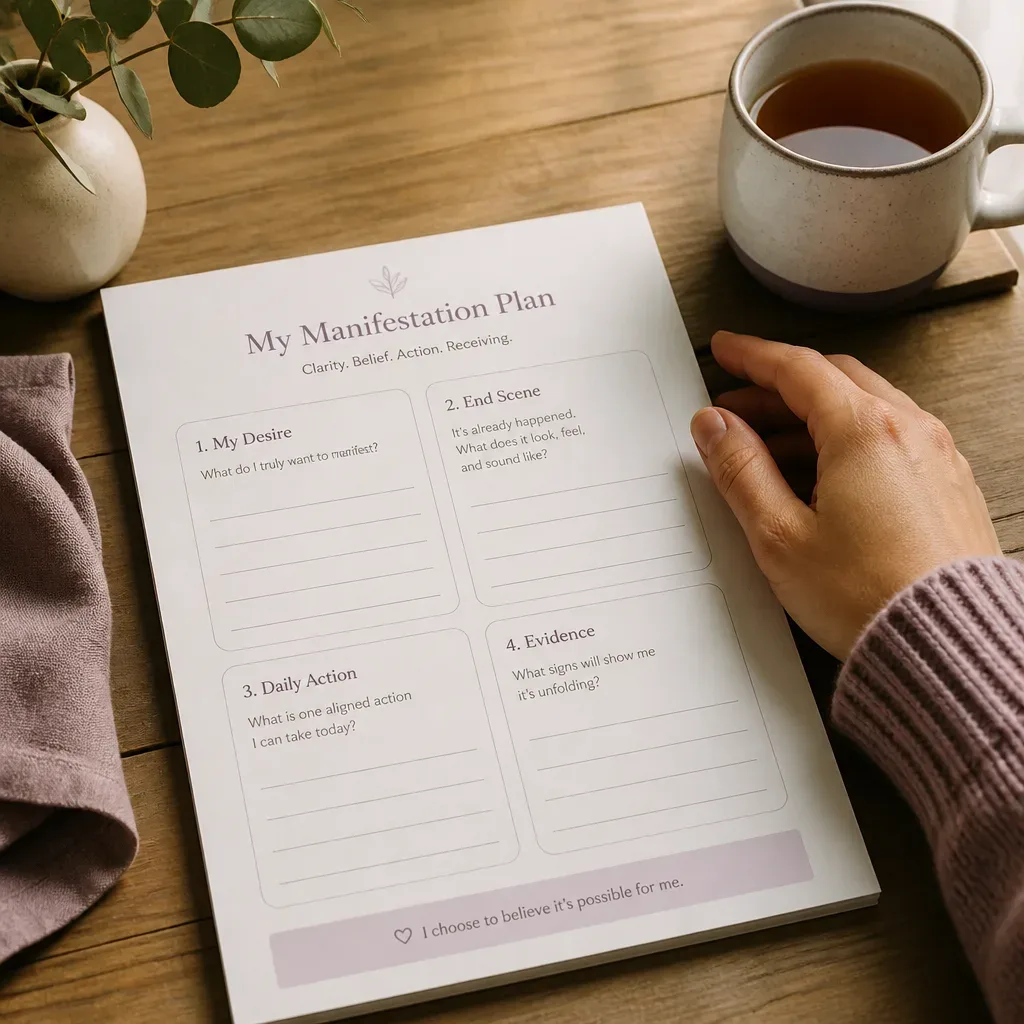
The simplest way to manifest is to write one end scene, rehearse it daily, act from it, and record evidence without checking obsessively.
Here is the beginner sequence I teach when a room is quiet enough to tell the truth:
- Name the desire in one line. Write it in present tense or plain future tense. Both can work. The important part is clarity.
- Choose an end scene. Pick a 10 to 30 second moment that would naturally happen after the desire is real.
- Add sensory detail. Include one thing you see, one thing you hear, and one thing you know in your body.
- Repeat daily. Give it 5 to 10 minutes. The Journal of Behavioral Medicine and related health psychology research have long associated consistent mental rehearsal with better self-regulation in specific behavior change contexts.
- Take one matching action. Do something small that your future self would not keep postponing.
- Track evidence. Write down changes in attention, choices, conversations, and timing.
Your end scene should be ordinary. Not fireworks. A text that says, “We’d like to offer you the role.” Your key turning in the lock of the apartment. Your hand resting calmly on the table after an honest conversation. The scene should be so simple that your body can enter it without performing.
This is why audio can help. The AYA Method is a daily audio manifestation practice. Each day you listen to a short personalized recording — your Dream-Self Moment — narrated from the version of you who has already manifested the life you intend. Listening is the practice. Repetition is the work. The audio is the method.
The app also includes a daily affirmation and a Manifestation Board, but they are complements. The listening is the center. For a beginner, this matters because you do not have to invent the practice every morning. You press play. You listen. You return.
Dr. Andrew Huberman has often spoken about the role of the nervous system in behavior and state change, especially how attention and arousal shape action. You do not need to force a peak state. A steady state repeated daily is often more usable. Five quiet minutes done 30 times will teach more than one dramatic hour you never repeat.
The practice that changes you is usually the one you are willing to do when nothing feels special.
How should manifestation feel in the body?
Manifestation should feel like a believable return to the desired state, not like pressure, bargaining, or pretending hard.
This is where many beginners get tired. They think they must feel certainty every second. Then one doubtful thought appears, and they decide they have ruined everything. You have not. A thought is not a demolition order. It is weather passing across the site.
The body matters because desire that stays only in language can remain brittle. When you rehearse your end scene, ask: what changes in my breath? Where do my shoulders go? What does my face stop doing? In small studies of mental imagery, athletes and patients practicing movement have shown measurable changes in readiness and performance-related pathways. The exact effects vary, but the practical lesson is simple: the brain and body respond to rehearsal.
You are not trying to fake joy. You are letting the body sample safety, worth, and completion. Sometimes the feeling is not excitement. Sometimes it is relief. Sometimes it is a clean silence after years of inner arguing. Neville Goddard’s phrase, the feeling of the wish fulfilled, is useful when it is kept gentle. Feeling does not mean theatrics. It means the state you would naturally occupy if the desire were no longer missing.
Try this 90-second body practice after your scene:
- Place one hand on your chest or the table.
- Name the desire once.
- Picture the end scene for 10 to 30 seconds.
- Ask, “If this were already true, what could soften by 5%?”
- Let one part of the body answer.
- End before you start straining.
The 5% is important. It respects the body. It gives the nervous system a small doorway instead of a command. Many therapeutic approaches, from somatic tracking to mindfulness-based stress reduction, use small shifts in attention because the body often trusts gradual contact more than force.
If you want more language support, use the Affirmations pillar as a companion, not a replacement for practice. A good affirmation is not a spell you shout at fear. It is a sentence you can repeat until it becomes less foreign.
What should you do after you visualize it?
After you visualize, take one small action that matches the person who already lives close to that desire.
This is the place where manifestation becomes honest. The inner scene opens the door. The next action walks through it. If you are manifesting a healthier body, drink water, book the appointment, prepare the meal, or sleep 20 minutes earlier. If you are manifesting work, send the email, update the portfolio, ask the question, practice the interview. If you are manifesting love, tell the truth kindly once.
Action does not have to be large. BJ Fogg’s behavior research at Stanford made a clear case for tiny habits: small, repeatable actions attached to existing routines can create durable change. His work often uses examples so small they seem almost too easy. That is the point. A habit that is too heavy will not stay in the day.
Use this after-practice table:
| If your desire is… | One matching action today |
|---|---|
| A new role | Send one tailored application |
| A calmer home | Clear one surface for 10 minutes |
| A loving relationship | Practice one honest sentence |
| More money | Review one bill or pitch one client |
| Creative confidence | Make one rough draft for 15 minutes |
The action should be close enough to do today. Not the whole bridge. One plank. When you act from the desired state, you teach the mind that this is not fantasy. It has hands. It has a calendar. It has a message sent at 4:12 p.m.
There is a quiet dignity in small proof. A person who wants to write becomes a person who writes 200 words. A person who wants peace becomes a person who turns off the phone at dinner. A person who wants to be chosen becomes a person who stops abandoning herself in the first conversation.
Manifestation is not waiting beautifully. It is behaving, in small ways, as if your yes is already allowed.
If symbols help you stay close to the desire, you might use a visual board or study how timing rituals work in Astrology and manifestation. Keep the order clear. The symbol serves the practice. The practice serves your life.

How do you know if manifestation is working?
Manifestation is working when your attention, choices, emotional steadiness, and outer opportunities begin to show movement in the direction of your desire.
Do not look only for the final result. That makes you harsh with the early evidence. Look for shifts in four places: what you notice, what you tolerate, what you choose, and what meets you. A beginner may first notice that the desired life no longer feels ridiculous. That counts. Then they may stop saying yes to what contradicts it. That counts too.
Keep an evidence log for 30 days. This is not magical bookkeeping. It is attentional training. Gratitude and positive writing studies, including work associated with Robert Emmons and Michael McCullough in the early 2000s, suggest that repeated noticing can affect mood and appraisal. You are not forcing yourself to be cheerful. You are training the mind to see what is no longer invisible.
Write three lines each evening:
- What did I notice today that relates to my desire?
- What action did I take, even if it was small?
- What did I refuse that no longer fits?
The third question is often the most revealing. Manifestation is not only calling something in. It is also becoming unavailable for what keeps teaching the old story. If you want calm, you may need to stop rehearsing emergency. If you want love, you may need to stop calling distance mysterious. If you want paid work, you may need to stop hiding the offer.
Some days will show nothing obvious. Keep going. In habit studies, change often appears unevenly because motivation, context, sleep, stress, and social support all affect behavior. A 2009 study by Phillippa Lally and colleagues found that habit formation averaged 66 days, with wide variation. Thirty days is not a law. It is a clean first room.
Your evidence log is not there to prove you are worthy. You already are. It is there to show you where the new pattern is beginning to hold.
What mistakes should beginners avoid?
Beginners should avoid changing desires daily, using manifestation to bypass action, and treating doubt as failure.
The first mistake is scattering. You practice one desire on Monday, another on Tuesday, and by Friday you are exhausted from redesigning the whole house. Choose one main desire for 30 days. You can care about other parts of life. Just do not ask the practice to hold every longing at once.
The second mistake is over-checking. You rehearse the scene, then spend the day asking, “Where is it?” Checking can become a ritual of absence. The mind hears the question under the question: it is not here. Give the desire a time to be practiced and a time to be lived from. Then do your day.
The third mistake is making doubt the enemy. Doubt may appear because your nervous system is meeting something unfamiliar. A 2022 American Psychological Association stress report found that many adults reported ongoing stress around money, health, and the future. Against that background, it is natural that a desired state may feel strange at first. Strange does not mean false.
Use these corrections:
- If you keep changing desires, return to the one that feels most honest.
- If you keep over-checking, set one daily practice window and stop outside it.
- If you keep doubting, lower the emotional demand and practice willingness.
- If you keep avoiding action, choose an action so small it is almost embarrassing.
- If you keep comparing, close the feed before you practice.
The fourth mistake is confusing tools with the work. A candle, notebook, chart, playlist, or board can support you. None of them can practice for you. If you want a larger foundation, return to how manifestation works and keep your daily method plain.
A tool is sacred only when it helps you return.
The fifth mistake is trying to manifest what violates another person’s freedom. You can manifest mutual love, honest repair, readiness, and courage. Do not use practice as control. The cleanest desire leaves room for other people to be real.
What does a beginner manifestation routine look like?
A beginner manifestation routine can take 15 minutes: settle, listen or visualize, write one line, take one action, and record evidence later.
Here is a simple daily structure:
| Time | Practice | Why it helps |
|---|---|---|
| 1 minute | Sit in the same place | The body recognizes repetition |
| 5 minutes | Listen to your Dream-Self Moment or rehearse your scene | Audio and imagery focus attention |
| 2 minutes | Write one sentence from the fulfilled state | Language steadies the state |
| 5 minutes | Take or schedule one matching action | Desire enters the day |
| 2 minutes at night | Record evidence | The mind learns what to notice |
The same chair helps. The same time helps. The same first sentence helps. Environmental psychology has long shown that settings cue behavior; even without a single perfect statistic, anyone who has worked at one desk and slept in another knows this truth in the body. A place can remind you who you are practicing becoming.
If mornings are crowded, do not force a heroic routine. Listen while sitting on the edge of the bed. Rehearse the scene before opening messages. Write one line on the train. The practice should fit inside your real life, not shame it for being real.
For beginners using the AYA Method, keep it even simpler: press play on the Dream-Self Moment each day, listen as if the scene is already yours, then choose one action that matches. The daily affirmation and Manifestation Board can support the same intention, but the audio remains the method.
A 15-minute practice is enough if you actually return to it. Ten minutes is enough. Five can be enough on a hard day. The measure is not intensity. It is continuity.
You may want to read more about affirmations if language steadies you, or astrology and manifestation if timing rituals help you listen. Let each support stay in its right place. The center is the repeated inner contact, followed by the next true action.
The chair is waiting. Sit down softly.