manifestation 101
Law of Assumption vs Future-Self Audio
Law of assumption practice asks you to live from the end. Future-self audio asks you to hear that end daily, softly, and repeat it.

The cup is still warm beside the bed. The law of assumption asks you to inhabit the state of the wish fulfilled. Future-self audio helps you hear that state every day. One is mostly silent. One is spoken into you. Both depend on repetition, not mood.
What does the law of assumption actually ask you to do?
The law of assumption asks you to accept your desired state as already true in imagination, then return to that inner fact again and again.
Neville Goddard made the phrase familiar in the 20th century, especially through books and lectures such as Feeling Is the Secret, first published in 1944. His claim was not that you should beg for a life outside you. It was that you should assume the inner position of the person who already has it. Not as performance. As identity.
That can sound simple until Tuesday arrives. Your phone is full. Your body is tired. The rent is real. You can say, I am chosen, I am well, I am safe, and still feel the old weather inside your chest. This is where the practice becomes less glamorous and more honest. An assumption is not a sentence you admire. It’s a place you agree to return to.
In practical terms, the law of assumption often uses three parts:
- a clear scene or inner knowing
- a felt sense of already being the person who lives it
- repetition, especially before sleep or after waking
Goddard often spoke about the drowsy border before sleep, sometimes called the state akin to sleep. Modern sleep researchers describe the hypnagogic period as a transition in which sensory processing and self-generated imagery can shift noticeably; even 10 to 20 minutes of presleep rumination has been linked with sleep quality in behavioral sleep research. The old teachers noticed something real: the mind is more porous when the day is soft.
If you want a wider frame for this kind of practice, the manifestation pillar names the broader field without pretending every method is the same. The law of assumption is one doorway. It asks for inner consent before outer proof. It is quiet, but not passive.
How is future-self audio different from silent assumption?
Future-self audio gives the assumed state a voice, so you don’t have to generate the whole practice from willpower alone.
The AYA Method is a daily audio manifestation practice. Each day you listen to a short personalized recording — your Dream-Self Moment — narrated from the version of you who has already manifested the life you intend. Listening is the practice. Repetition is the work. The audio is the method.
That definition matters because it keeps the center clear. The method is not a mood board with sound added. It is not a list of wishes read louder. It is a daily act of hearing yourself from the life you’re practicing toward. A few minutes. The same direction. Again.
The difference is sensory. Silent assumption asks you to hold an inner state. Audio gives your nervous system tone, pace, breath, and sequence. Neuroscience doesn’t prove manifestation as a mechanism, and it shouldn’t be used that way. But auditory repetition is well studied. In learning research, repeated listening supports memory through cueing and recall; a 2014 review in Frontiers in Psychology described music and speech as strong carriers of autobiographical memory. Voice can bring a state back faster than a paragraph can.
This is why tired people often prefer audio. You don’t have to build the scene from nothing. You press play. You listen. You let the future self speak in first person, as if she has already crossed the room and is calling you home.
The voice you repeat becomes easier to find under pressure. That isn’t magic. It’s rehearsal. Athletes, performers, and clinicians have used mental rehearsal for decades; a 2015 paper in Neuropsychologia noted that motor imagery and action observation can recruit overlapping brain systems. Future-self audio belongs in that family of inner rehearsal, with one difference: the rehearsed action is identity.
Which one is easier to keep when life gets loud?
Future-self audio is usually easier to keep because it reduces the number of decisions you need to make before practicing.
Most people don’t fail a practice because they don’t care. They fail because the practice asks for too many choices. What do I say? How do I feel it? Am I doing it correctly? How long should I stay here? Each question takes a little charge. By the time the practice begins, the mind is already negotiating.
Habit research is useful here. In a 2009 study in the European Journal of Social Psychology, Phillippa Lally and colleagues found that a new behavior took a median range from 18 to 254 days to become automatic, with an average often cited as 66 days. The number is less important than the mercy inside it. Your practice may need many returns before it feels natural.
| Practice | Best when | Main risk | Daily cue |
|---|---|---|---|
| Law of assumption | You can access imagination easily | You start testing reality every hour | Before sleep or during a quiet pause |
| Future-self audio | You’re tired, busy, or emotionally full | You listen without receiving it | Same time, same headphones, low friction |
| Written affirmations | You need one clear sentence | It becomes mechanical | Notebook, mirror, or lock screen |
| Visual board | You need to see direction | It becomes decoration | Morning glance, weekly edit |
Silent assumption can be intimate. It can also become a private courtroom. You assume the state, then check your life for evidence, then accuse yourself when the evidence is late. Audio interrupts that loop by giving you something to receive, not merely perform.
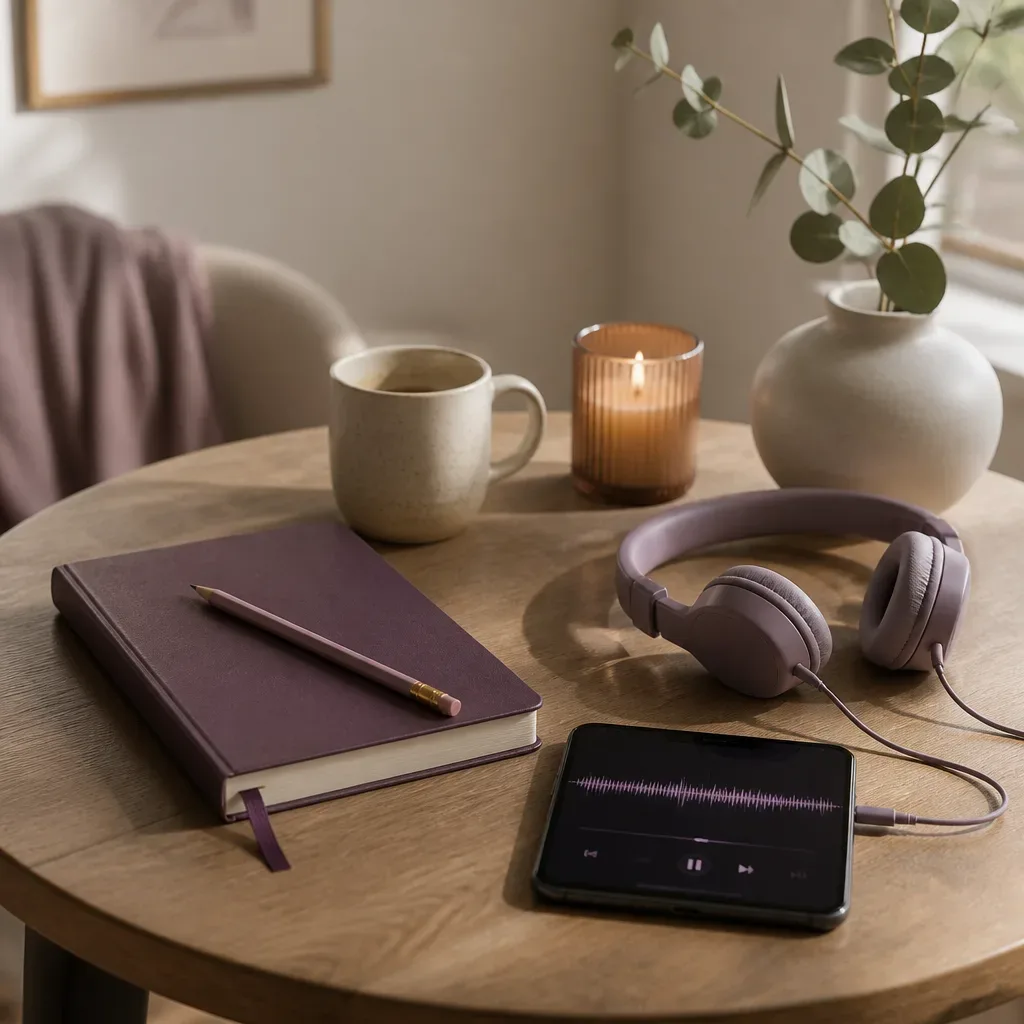
That doesn’t make audio better for everyone. Some people need silence. Some need writing. Some need one sentence from the affirmations practice and nothing more. The question is not which method sounds most impressive. The question is which one you will still do on a low day.
A practice that survives your worst week is more useful than a practice that flatters your best self.
How do you compare belief, repetition, and the body?
Belief matters, but repetition often carries the practice before belief fully arrives.
Many people wait to feel certain before they begin. The law of assumption can make this more intense because the instruction seems to be: believe it now. But belief is rarely a switch. It is often a groove. You return, and return, until the new thought is less foreign in your mouth.
Future-self audio uses repetition as a bridge. You may not believe the first listening. You may not believe the tenth. But your body begins to recognize the words. A 2018 review in Psychological Bulletin on habit formation emphasized the role of stable context cues and repeated behavior. Same bed. Same walk. Same headphones. The cue becomes part of the practice.
Here is a simple way to think about the difference:
- The law of assumption begins with inner occupancy.
- Future-self audio begins with listening.
- Both ask you to stop rehearsing the old self as the only real self.
- Both become steadier when attached to a daily cue.
- Neither works well when used as a way to punish yourself.
This is also where the body enters. Dr. Andrew Huberman has often discussed the link between breath, autonomic state, and attention in public neuroscience education; the wider clinical literature supports that slow breathing can reduce physiological arousal in many people. If your body is braced, assumption may feel fake. If the audio is spoken slowly, with enough space, it can help the body stop arguing for a moment.
The comparison is not belief versus sound. It is belief supported by sound. Or belief supported by silence. Choose the support your actual nervous system can accept.
Where do affirmations, boards, and astrology fit beside these practices?
Affirmations, visual boards, and astrology can support manifestation, but they are not the center of future-self audio.
The daily affirmation is useful because it gives you one sentence to carry. One sentence can interrupt an old sentence. That is not small. In cognitive behavioral traditions, short replacement statements are often used to challenge automatic thoughts; Aaron Beck’s early work in the 1960s helped bring attention to the way repeated thoughts shape feeling and action. A clean affirmation can become a handrail.
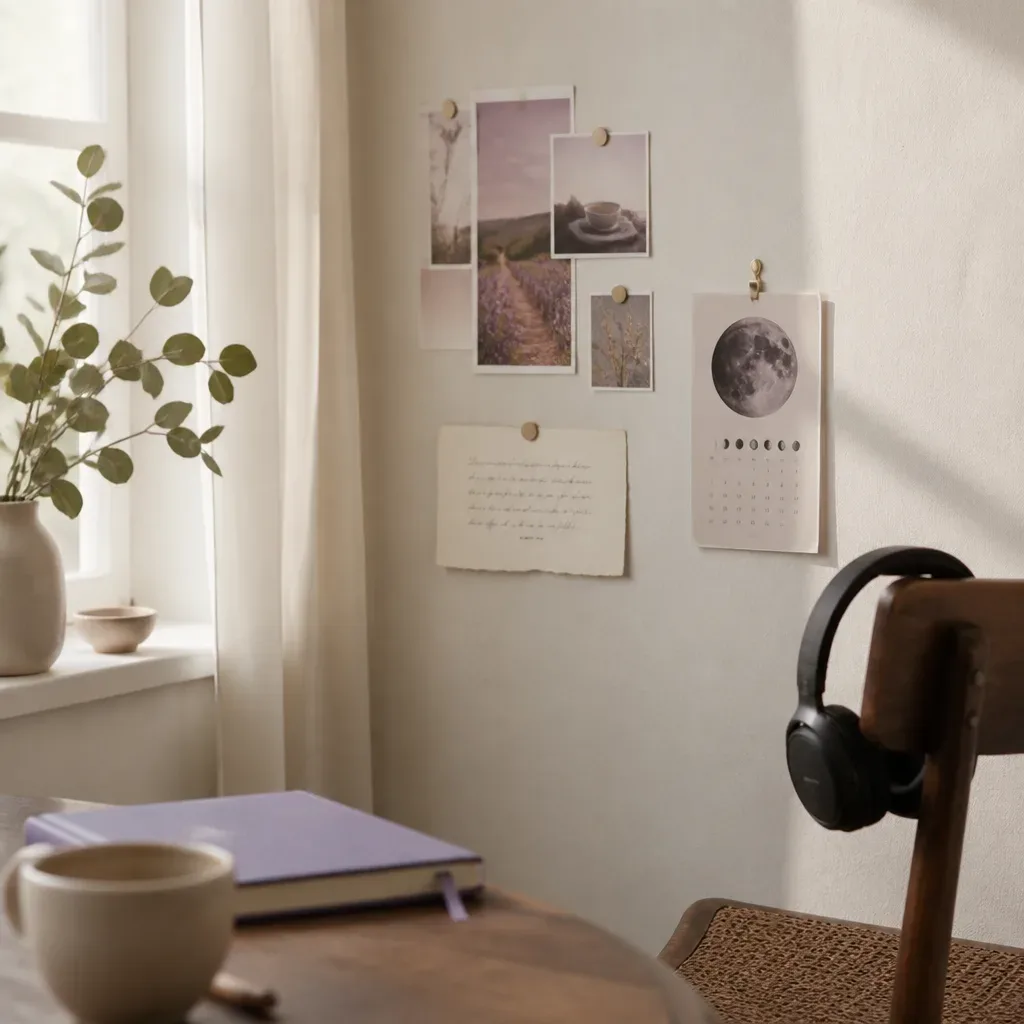
A Manifestation Board is different. It is the part you can see. Images help when words feel too thin. Visual cues are known to affect attention; even simple goal reminders have been studied in environmental and behavioral psychology, though results depend heavily on context. A board should not become an altar to wanting. It should become a reminder of what you’re practicing as already yours.
Astrology sits beside the practice in another way. It can give timing, reflection, and symbolic language. If you use astrology and manifestation, keep it gentle. A transit can name a season. It doesn’t replace your daily listening. The moon can mark the page, but you still have to write the sentence.
Here is the clean hierarchy:
- The audio is the method.
- The Dream-Self Moment is the daily center.
- The affirmation is a complement.
- The Manifestation Board is a complement.
- Astrology can be a reflective frame, if it helps you return.
This matters because scattered practice creates scattered attention. If everything is equal, nothing is central. The quiet strength of the AYA Method is that it asks for one daily act first: listen.
You don’t need more signs when you have a practice you can keep.
Which practice should you choose for your own life?
Choose the law of assumption if silence feels natural; choose future-self audio if you need a repeatable voice to help you return.
There is no prize for choosing the harder method. If you have a vivid imagination and you can rest in the fulfilled state without checking every hour, the law of assumption may fit you well. It asks for inner loyalty. It asks you to live from the end before the world applauds.
If your days are crowded, future-self audio may be kinder. You can listen while sitting on the floor, walking slowly, or lying in bed before the inbox begins. According to Pew Research Center, about 31% of U.S. adults reported being online almost constantly in 2021. Constant input makes self-generated stillness harder for many people. Audio can become a small counter-input: chosen, personal, repeated.
Use this decision guide:
| If you notice this | Try this first |
|---|---|
| You overthink every phrase | Future-self audio |
| You love inner visualization | Law of assumption |
| You need one sentence only | Daily affirmation as support |
| You need visible reminders | Manifestation Board as support |
| You keep starting over | Same audio cue for 30 days |
You can also combine them without making the practice heavy. Listen to your Dream-Self Moment. Then sit for 30 seconds and let the law of assumption do its quiet work. Don’t add ten tasks. Don’t make a ceremony out of proving you’re serious.
Research on meditation use offers a useful parallel. The CDC reported that U.S. adult meditation use rose from 4.1% in 2012 to 14.2% in 2017. The rise didn’t make every practice equal. It showed that people were looking for repeatable ways to meet their own minds. Manifestation practice needs the same honesty. Repeatability first. Beauty later.
For a broader map, you can return to the manifestation guide, then keep the daily act small enough to survive real life. The best method is not the one that impresses you on Sunday. It is the one waiting for you on a tired Tuesday.
Put the voice near your pillow, and let it be enough.