manifestation 101
Robotic Affirming vs Future-Self Audio
Robotic affirming repeats a phrase until it feels familiar. Future-self audio uses voice, imagery, and listening to make the desire feel lived.
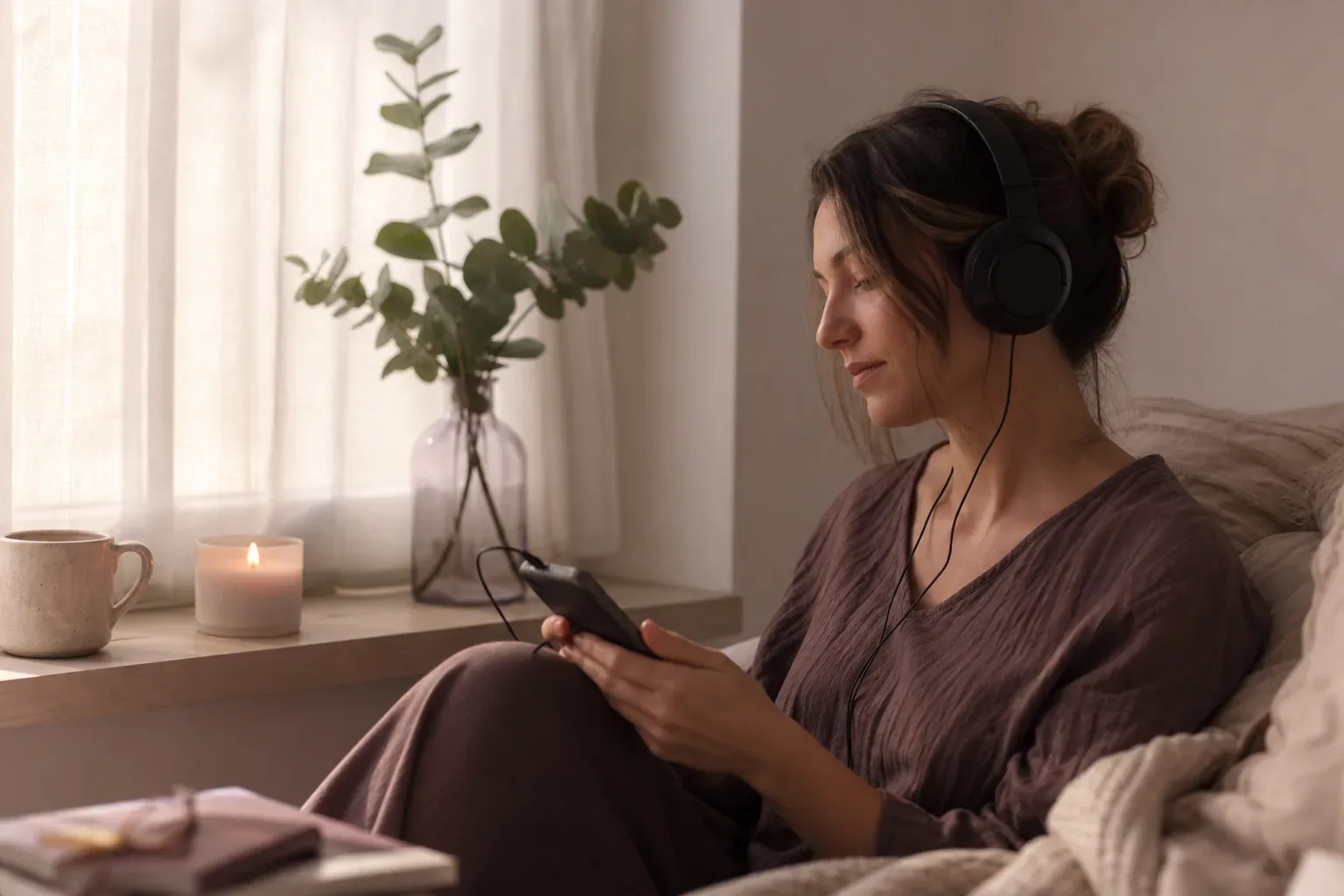
The phrase sits on your tongue before coffee. Robotic affirming means repeating one chosen statement until it becomes familiar. Future-self audio asks you to listen instead, letting a spoken scene carry the new identity. Both use repetition. The difference is effort: one is spoken by you, one is received by you.
What is robotic affirming, really?
Robotic affirming is affirmation by repetition, often without trying to feel the words.
It is usually simple. One sentence. Sometimes five words. You repeat it while washing a cup, walking to the tram, lying awake at 2:13 a.m. The word “robotic” is not an insult here. It names the plainness of the method. You are not trying to become poetic. You are trying to become consistent.
Many people use phrases like “I’m chosen,” “It’s already done,” or “Money comes to me easily.” The sentence is repeated dozens or hundreds of times. In habit research, repetition matters: Phillippa Lally and colleagues found in a 2009 European Journal of Social Psychology study that automaticity took a median of 66 days to form, with a wide range from 18 to 254 days. The body is slow. That is not a failure.
Robotic affirming sits close to traditional affirmations, but it strips away ceremony. No candle. No perfect notebook. No mood requirement. That is why people like it. It can be done in a queue, in bed, in the lift, in the bathroom at work. A practice that can survive a Tuesday has already passed one serious test.
Still, the practice has a tender problem. If the phrase is too far from what you can bear to hear, your mind may begin cross-examining it. A 2009 Psychological Science paper by Joanne Wood, W. Q. Elaine Perunovic, and John Lee found that positive self-statements could make people with low self-esteem feel worse. Not always. Not for everyone. But enough to take seriously.
Repetition is not proof. It is a place to stand.
The quiet question is not whether robotic affirming is real enough. The question is whether your chosen phrase gives you somewhere to return, or another place to argue.
What is future-self audio doing differently?
Future-self audio uses listening, voice, and narrative to help you rehearse a life as if it is already familiar.
This is where the AYA Method comes in, without fanfare. The AYA Method is a daily audio manifestation practice. Each day you listen to a short personalized recording — your Dream-Self Moment — narrated from the version of you who has already manifested the life you intend. Listening is the practice. Repetition is the work. The audio is the method.
That last sentence matters. The audio is not a decorative layer over the real practice. It is the practice. You press play. You hear a version of your life described from the inside. The app also includes a daily affirmation and a Manifestation Board, but those are complements. The center is the Dream-Self Moment, spoken in the voice of the future self you are learning to recognize.
Future-self audio borrows from several older doors. Neville Goddard taught “living in the end,” the inner act of occupying the fulfilled state. Joe Dispenza often speaks about mentally rehearsing a future until the body begins to learn it. Neuroscientists have studied mental imagery for decades; one 1995 study by Pascual-Leone and colleagues found that mental practice of a piano exercise changed motor cortical maps in ways that overlapped with physical practice. The mind rehearses. The body listens.
The difference is ease. With robotic affirming, you produce the sentence. With future-self audio, you receive the scene. That matters when you are tired, resistant, or too clever for your own peace. Audio lets your future self arrive without asking your tired mind to perform belief.
Future-self audio also gives the brain more hooks. There is voice, pacing, detail, and sequence. Cognitive psychology has long shown that memory improves when information has multiple cues; Allan Paivio’s dual coding theory, first developed in the 1970s, argued that verbal and imaginal systems can reinforce one another. A sentence may be enough. A spoken scene may be easier to live inside.
Which one works better when your mind is noisy?
Future-self audio is often gentler when your mind is noisy, while robotic affirming can help if you need a very small anchor.
There are mornings when thought is not thought. It is a stack of open tabs. In that state, robotic affirming can be helpful because it gives the mouth one job. You do not have to solve the whole interior weather. You say the line. Again. Then again. Some people use 3 minutes. Some use 10. Some count 100 repetitions, which is tidy enough to soothe the part of the mind that likes numbers.
But noise can turn repetition into pressure. If you repeat “I am safe” while your body is saying “not yet,” the sentence may begin to feel like a small argument. This is where future-self audio can be kinder. You are not commanding yourself to believe. You are listening to a scene. In clinical settings, guided imagery has been studied for stress and pain; a 2019 review in Frontiers in Psychology described guided imagery as a low-cost practice with evidence for reducing anxiety in several populations, though study quality varies.
A comparison may make the choice clearer.
| Question | Robotic affirming | Future-self audio |
|---|---|---|
| What do you do? | Repeat one phrase | Listen to a personalized scene |
| How much effort? | Moderate, because you generate it | Low, because you receive it |
| Best moment | Walking, waiting, brief pauses | Morning, bedtime, a quiet seat |
| Main risk | Feeling fake or forced | Becoming passive if you never act |
| Main gift | Simplicity | Felt identity rehearsal |
Neither practice should be treated like a test of spiritual talent. The American Psychological Association has noted for years that stress affects concentration, sleep, and decision-making; under stress, smaller practices are more likely to be kept. The quiet test is not how sincere you sound. It is whether you return tomorrow.
If you love clean edges, robotic affirming may suit you. If you need to be spoken to gently before you can believe yourself, future-self audio may suit you better. Both belong inside the wider field of manifestation, but neither needs to become loud.
Where does each practice fit in a real day?
Robotic affirming fits into scraps of time; future-self audio fits best into a protected listening pocket.
I like practices that can live beside a life that already exists. Not the fantasy life with linen sheets, no emails, and a body that wakes before the alarm. The actual life. The one with a missing sock and a message you forgot to answer. BJ Fogg’s behavior design work at Stanford has often emphasized making habits tiny enough to attach to existing routines. That is not laziness. It is engineering with mercy.
Robotic affirming is easiest to attach to motion. You can repeat one phrase while brushing your teeth for 2 minutes. You can use the first 6 minutes of a commute. You can say it silently while walking from the bus stop to the door. Because it has no setup, it is hard to excuse yourself from it. This is its beauty.
Future-self audio asks for a little more room, though not much. A 3 to 7 minute recording can fit before you stand up, after lunch, or just before sleep. Dr. Andrew Huberman has often spoken about the nervous system’s state shaping learning and attention; whether or not you follow his protocols, the simple point holds. A calmer body receives differently than a rushed one.
Here is a practical way to place them:
- Use robotic affirming in the “between” places: stairs, queues, walks, washing dishes.
- Use future-self audio in one chosen place: bed, chair, bus seat, morning light.
- Keep the same phrase or recording for at least 14 days before judging it.
- Notice your body, not only your thoughts.
- Choose the practice you can repeat when life is ordinary.
The daily affirmation inside Aya can give you a sentence to carry, but it is not the main event. The Manifestation Board can give your eyes something to return to, but it is not the main event either. Listening is the method. The Dream-Self Moment is the practice you keep coming back to.
What if affirmations have always felt fake to you?
If affirmations feel fake, the sentence may be too far from your current self-concept, or the delivery may not fit you.
This is not a character flaw. Some readers can say “I am deeply loved” and soften. Others hear it and immediately produce a legal brief against it. The mind is very talented when it wants to stay loyal to an old identity. In self-affirmation theory, Claude Steele’s 1988 work suggested that people protect a global sense of self-integrity, not just one belief. A phrase that threatens the old arrangement may be resisted.
Robotic affirming can still work if you lower the temperature. Instead of “I am rich,” try “I’m getting used to receiving more.” Instead of “Everyone chooses me,” try “I’m learning to be easy to choose.” This is not weakening the practice. It is making the bridge walkable. A sentence does not need to impress anyone. It needs to be repeatable without making you flinch.
Future-self audio helps because it does not always confront you with a blunt claim. It can show you the morning after the thing has settled. The email already sent. The keys already in the bowl. The body already less braced. The new life appears through ordinary detail. That is often where belief enters quietly.

If you want the wider map, read the manifestation pillar and the affirmations pillar as companion shelves. They are different books. Manifestation asks what you are rehearsing as true. Affirmations ask what sentence you are willing to repeat. Audio asks what future self you can bear to hear until it starts to sound like home.
A sentence does not have to be grand to be faithful.
Some people also time their practice with moon phases, birth charts, or seasonal markers. If that is you, the guide to astrology and manifestation may help you use timing as a support, not a substitute. A calendar can remind you. It cannot listen for you.
How do you test robotic affirming against future-self audio?
Test both for two weeks each, using the same desire, the same time of day, and a simple record of what changes.
Fourteen days is not magic. It is just long enough to move past novelty and short enough that you will not make a religion out of the test. In behavior studies, longer windows are often better, but small experiments are easier to finish. The library taught me this. The ambitious books come back with bookmarks at page 23. The slim ones come back worn at the spine.
Choose one desire. Not twelve. Choose one line for robotic affirming and one Dream-Self Moment for audio. Keep the wording close. If the desire is being seen in your work, your robotic phrase might be “My work is seen by the right people.” Your future-self audio might describe a morning where you open a message, feel steady, and know your work has reached someone real.
Use a small scorecard. Nothing dramatic.
- Ease: Did I resist starting, from 1 to 5?
- After-feeling: Did I feel softer, steadier, or more tense?
- Return: Did I want to do it again the next day?
- Spillover: Did I make one action that matched the desire?
- Truth: Did the practice feel false, neutral, or quietly possible?
Action matters. Oettingen and Gollwitzer’s research on mental contrasting and implementation intentions has shown that desired futures work better when paired with obstacles and specific next steps. A practice that never touches behavior can become a beautiful waiting room. You are allowed to listen and then send the email.
At the end of 28 days, do not ask which practice made you feel more impressive. Ask which one made you more honest, more steady, and more likely to take the next small action. For many people, the answer will be a blend: future-self audio once a day, robotic affirming in the cracks.
Which practice should you choose now?
Choose robotic affirming if you need a portable phrase; choose future-self audio if you need a held scene you can return to daily.
There is no prize for making this complicated. If your days are crowded, start with one phrase for 3 minutes. If your mind is tired of making words, start with one recording. If you already use the AYA Method, let the Dream-Self Moment be the center and let a single affirmation follow you through the day like a small note in your pocket.
You can also choose by temperament. Some people trust what they say. Some trust what they hear. Some need both. A 2022 Pew Research Center report found that many adults use digital tools for health, prayer, meditation, or habit support, but use varies widely by age and context. The tool is never the tender part. The return is.
Here is the simplest decision:
| If this is true | Start here |
|---|---|
| I overthink every sentence | Future-self audio |
| I need something I can do anywhere | Robotic affirming |
| I hate long routines | Either, but set a 3-minute limit |
| I want sensory detail | Future-self audio |
| I want one clear command for my attention | Robotic affirming |
| I want to pair listening with visible reminders | Audio, with the Manifestation Board as support |
Robotic affirming is not lesser because it is plain. Future-self audio is not better because it is more beautiful. The question is fit. A practice that requires a different nervous system than the one you have will not be kept.
So begin where there is the least friction. Repeat the sentence. Or press play. Stay for the whole small thing. Then go make tea, answer the message, wash the cup.
Softly is still a way of beginning.